Foods to avoid with kidney disease / Coffee
For most people with kidney disease, the black cup is fine. Brewed coffee carries about 116 mg potassium per cup, roughly 6% of the 2,000 mg reference many renal diets use, and a nearly invisible 7 mg of phosphorus. Cohort studies point the same way: people who drink coffee develop chronic kidney disease somewhat less often than people who drink none. The questions that deserve real attention sit around the cup: what you pour into it, and whether you have a daily fluid limit that each cup spends.
By the MedMenu Editorial Team · Published August 11, 2026
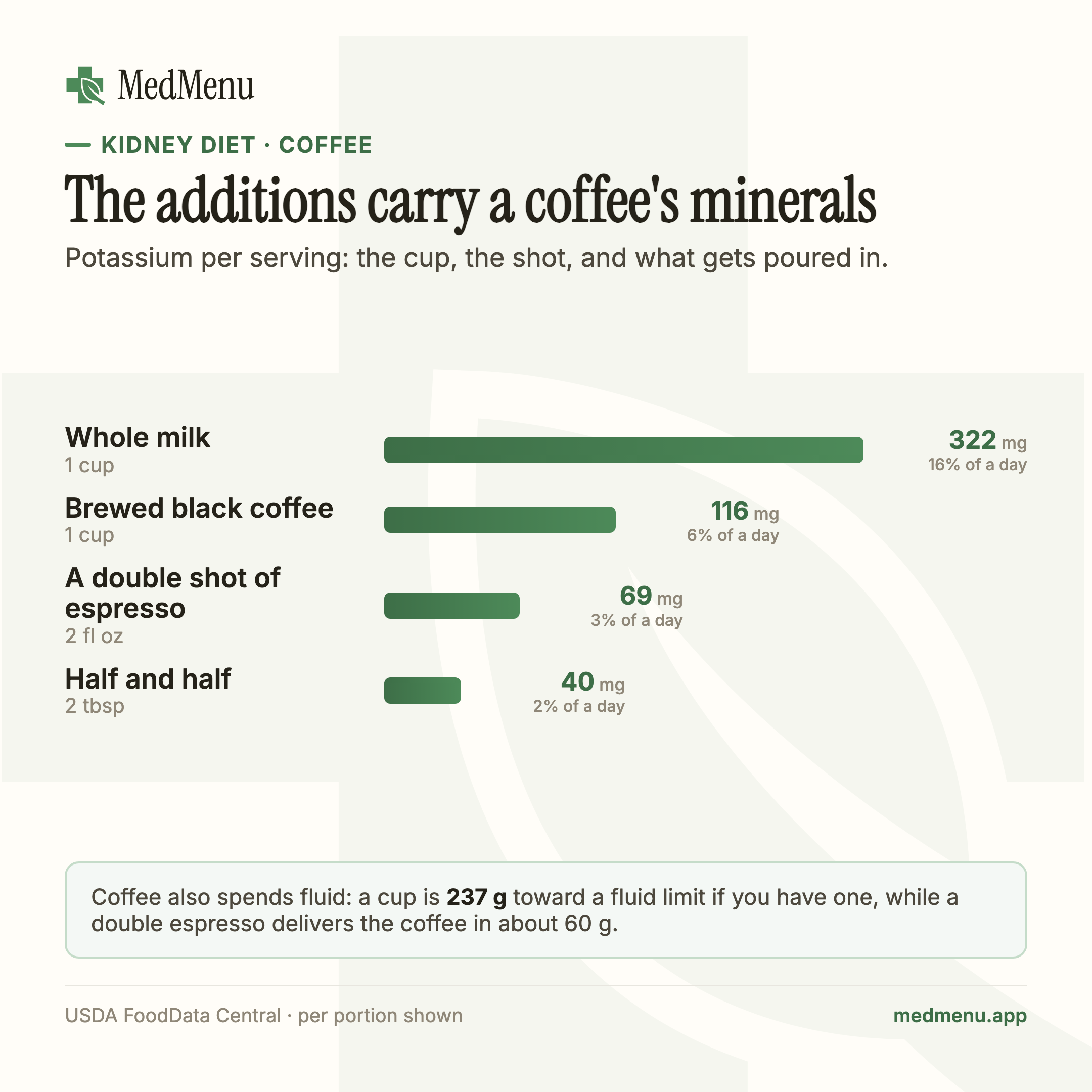
The brew, the concentrated shot, and the two most common things poured on top. Per USDA FoodData Central:
| Portion | Potassium | Phosphorus | Fluid |
|---|---|---|---|
| Brewed black coffee, 1 cup (237 g) | 116 mg | 7 mg | 237 g |
| A double shot of espresso, 2 fl oz (60 g) | 69 mg | 4 mg | 60 g |
| Half and half, 2 tbsp (30 g) | 40 mg | 28 mg | 30 g |
| Whole milk, 1 cup (244 g) | 322 mg | 205 mg | 244 g |
The last row is what a large latte holds. The milk in it carries close to three times the potassium of the black coffee it replaces, and its 205 mg of phosphorus is a real share of a 1,000 mg reference day, against the coffee's 7.
Espresso is the concentrated case worth understanding: per gram it carries more than double the potassium of drip (115 against 49 mg per 100 g), and it still lands lower per serving because the serving is small. Both readings are true; the portion decides which one matters for your day.
The population evidence leans gently positive. A meta-analysis pooling four cohort studies, 25,849 people in total, found that coffee drinkers went on to develop chronic kidney disease about 13% less often than non-drinkers, a risk ratio of 0.87 with a confidence interval of 0.81 to 0.95 (Srithongkul and Ungprasert, 2020).
That finding deserves its honest frame: these are observations of mostly healthy people and the outcome is developing kidney disease in the first place. The studies say coffee sits comfortably in a kidney-conscious life; they say nothing about coffee treating kidney disease that already exists. For someone already diagnosed, the practical questions stay the two in this article, minerals in the cup and fluid in the day.
Caffeine itself is a separate conversation from minerals, and one your care team weighs against blood pressure and sleep the same way they would for anyone.
Fully. A cup of coffee is 237 g of fluid, the same spend as a cup of water, and people with advanced kidney disease or on dialysis are often given a daily fluid allowance set by their care team. Three mugs across a morning can quietly commit 700 g of it before lunch.
Espresso is the fluid-limit trade: a double shot delivers the coffee experience in about a quarter of a cup's fluid, at 69 mg potassium. An americano built from that shot and a small pour of hot water sits anywhere between the two, which puts the slider in your hands rather than the menu's.
Black coffee carries no carbohydrate, so the cup itself asks nothing of blood sugar. The drinks list is where the two conditions meet:
The whole breakfast that surrounds the mug is mapped in our low-potassium breakfast guide.
Every figure comes from USDA FoodData Central (Standard Reference legacy) for the named beverage: brewed coffee prepared with tap water, restaurant-prepared espresso, fluid half and half, and whole milk, at the portion shown. For scale, many kidney diets use around 2,000 mg potassium and 1,000 mg phosphorus a day as common working references. Fluid allowances, where they apply, are individual prescriptions from your care team. There is no single limit that fits everyone; your labs and stage set yours.
Sources
MedMenu is an information tool, not medical advice, and does not diagnose, treat, or manage any condition. Your nephrologist and renal dietitian set your personal targets from your labs and stage. Published August 11, 2026 · Last updated August 11, 2026.
This is a comprehensive website! Recipes look great and represent a variety of cuisines. You have emphasized the appropriate nutrients. Guidance tips are helpful. Science tab provides evidence-based references and are appropriate for the diseases addressed. Links to Drugs.com, WebMD & Medline are nice. As a registered dietitian, I feel comfortable recommending MedMenu.
Susan G. Rodder, MS, RDN, LD
Registered Dietitian
MedMenu offers all the data you need to plan meals based on specific dietary needs. There are lot of great recipes from a variety of cuisines to choose from, or you can test your own recipe to see how well it fits into your dietary guidelines.
Valerie B.
MedMenu user
Diabetically Speaking with SmartMove360
For most people, yes. A cup of black coffee carries about 116 mg potassium, roughly 6% of the 2,000 mg reference many kidney diets use, and 7 mg phosphorus. In a meta-analysis of four cohort studies covering 25,849 people, coffee drinkers went on to develop chronic kidney disease about 13% less often than non-drinkers. Two situations change the answer: a prescribed fluid limit, where every cup counts, and habitual milky or sweetened coffee drinks, where the additions carry more minerals than the coffee.
Yes, fully. A standard cup is 237 g of fluid, the same as a cup of water, and people with advanced kidney disease or on dialysis are often given a daily fluid limit their care team sets. A double shot of espresso delivers the coffee in about 60 g of fluid with 69 mg potassium, which is why espresso drinks are a common trade on restricted days.
The milk usually outweighs the coffee. A full cup of whole milk, the amount in a large latte, carries about 322 mg potassium and 205 mg phosphorus, close to three times the potassium of the black coffee underneath it. A 2-tablespoon splash of half and half is a different scale entirely, about 40 mg potassium and 28 mg phosphorus. The size of the dairy, and its phosphate where the creamer is processed, is the number to watch.
Rather not count?
A printable week with the potassium, phosphorus and sodium worked out for every meal and drink, so the portions are handled for you.
See the meal plan →