Kidney diet · Portion guide
The honest answer is not a banned list. Potassium and phosphorus are dose-dependent, so the real question for almost every food is how much, not whether. Below are the exact numbers from the USDA database, the portion that fits a typical renal budget, and what changes if you also have diabetes.
By the MedMenu Editorial Team · Published July 20, 2026
A whole avocado is a problem on a renal diet, but a quarter of one usually fits, and that portion difference is what a simple "foods to avoid" list gets wrong. Instead of banning foods, fit them against your daily budget:
Your nephrologist and renal dietitian set your personal targets from your labs and stage. Use the numbers below to see how portions add up against them.
Yes, in portion. A quarter avocado is about 242 mg potassium and fits most renal daily budgets; a whole one is roughly 975 mg and usually does not. Think in quarters, not "banned." The avocado guide has the full half and whole breakdown. With diabetes: avocado is a rare win here, low carb, so it will not spike blood sugar.
A whole medium banana is 422 mg potassium, a big share of a 2,000 mg day. Half a banana can fit if you count it. With diabetes: also watch the ~27 g carbohydrate; pair it with protein.
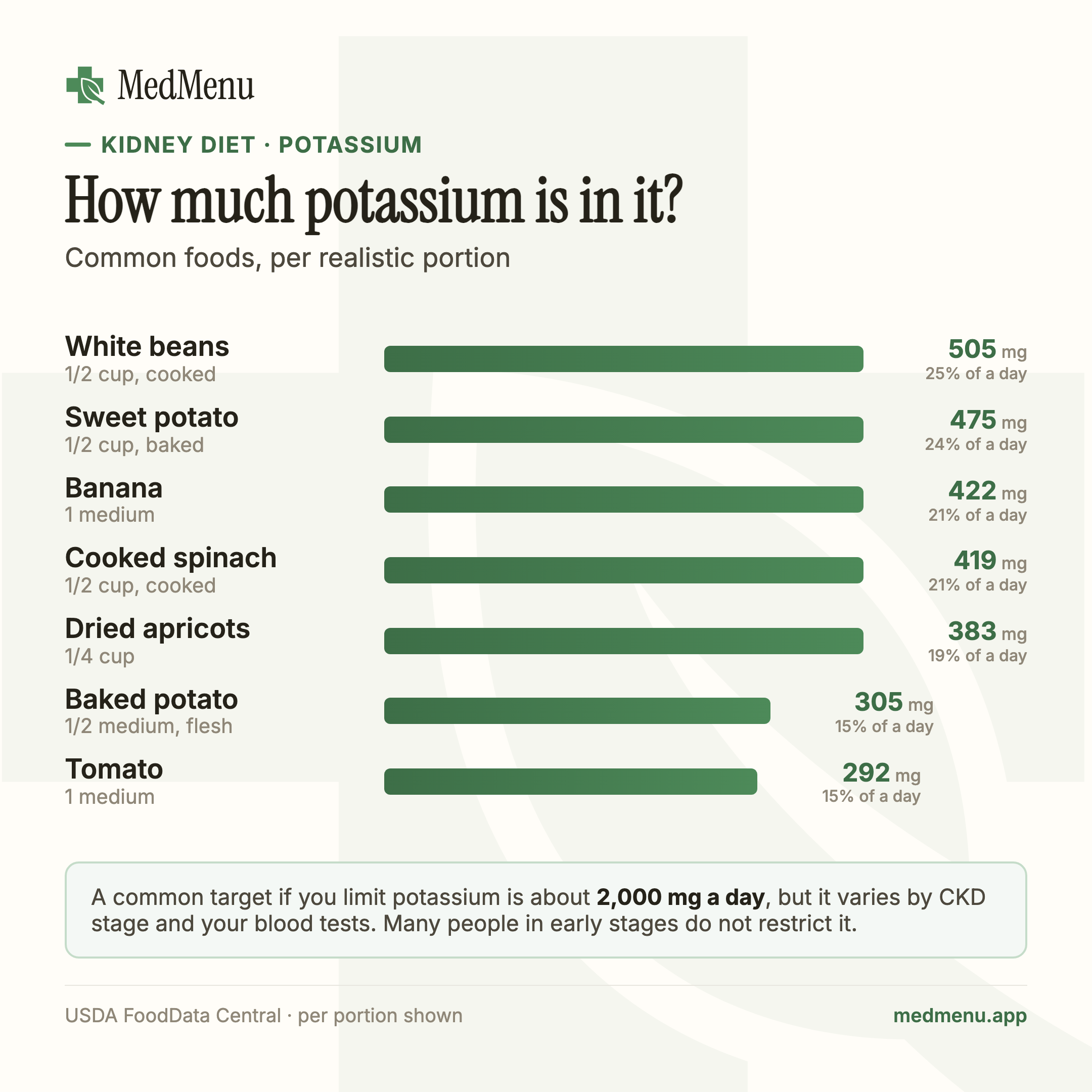
Half a medium baked potato (flesh) is about 305 mg potassium; half a cup of baked sweet potato is about 475 mg, higher than its reputation suggests (see can you eat sweet potatoes with kidney disease). Boiling or soaking cut pieces lowers potassium further. With diabetes: leaching removes potassium but not the ~17–21 g carbohydrate, and both are high on the glycemic index.
A medium tomato is about 292 mg; a medium orange about 237 mg. Both fit in single servings; with tomatoes it is the processed forms (sauce, paste, juice) that climb, and the tomato guide has those numbers. With oranges it is the juice: a cup runs 496 mg, more than double the whole fruit, and the orange guide breaks that down. With diabetes: whole fruit beats juice, because the fiber blunts the sugar and you eat less.
These concentrate potassium fast: half a cup of cooked spinach is 419 mg, half a cup of white beans 505 mg, a quarter cup of dried apricots 383 mg. Small portions, counted, or swapped: two fresh apricots are 181 mg, and the fruit list by serving has the rest of the fresh-for-dried trades. With diabetes: beans are actually a blood-sugar friend (low glycemic, high fiber); the trade-off here is the potassium and phosphorus, not the carbs.
The additive phosphate in processed food is absorbed almost completely, while phosphorus in whole foods is absorbed far less. So a cola is a bigger real-world problem than its modest label number suggests, and reading ingredient lists for "phosphate" matters as much as counting milligrams.
A cup of whole milk is about 205 mg phosphorus; an ounce of cheddar about 127 mg (plus 183 mg sodium). Portion-friendly in small amounts. A processed cheese slice runs meaningfully higher on both minerals for the identical ounce; see natural vs processed cheese. With diabetes: milk adds ~12 g carbohydrate per cup; cheese is near-zero carb.
An ounce of almonds is about 135 mg phosphorus (and 205 mg potassium); half a cup of lentils about 178 mg. These are whole-food phosphorus, so less of it is absorbed. Not every nut lands the same; see almonds vs cashews. With diabetes: nuts and lentils are low-glycemic wins; portion them for the minerals.
Dark colas add phosphoric-acid phosphate that is nearly fully absorbed, plus about 38 g of carbohydrate per can. This is the phosphorus to cut first, because it is additive, not whole-food, and a trial found that avoiding these additives moved people's blood phosphorus (the evidence and the label tell). With diabetes: an easy double win to drop.
Watching both minerals? See our list of foods low in both potassium and phosphorus.
Kidney guidelines generally put sodium under 2,300 mg a day. Most of it hides in processed and restaurant food, not the salt shaker: cured meats, canned soup, and bouillon are the usual culprits. See our list of foods low in both sodium and potassium for what to build from instead.
Important: most "salt substitutes" swap sodium for potassium chloride. On a kidney diet that can push blood potassium to dangerous levels, because damaged kidneys clear it poorly. Check the label for potassium chloride and talk to your care team before using one.
Values from USDA FoodData Central, per the portion shown. Potassium and phosphorus in milligrams.
| Food | Portion | Potassium | Phosphorus | Sodium |
|---|---|---|---|---|
| Banana | 1 medium | 422 | 26 | 1 |
| Avocado | 1/4 | 242 | 26 | 4 |
| Baked potato | 1/2 med, flesh | 305 | 39 | 4 |
| Sweet potato | 1/2 cup | 475 | 54 | 36 |
| Tomato | 1 medium | 292 | 30 | 6 |
| Orange | 1 medium | 237 | 18 | 0 |
| Cooked spinach | 1/2 cup | 419 | 50 | 63 |
| White beans | 1/2 cup | 505 | 102 | 5 |
| Dried apricots | 1/4 cup | 383 | 23 | 3 |
| Whole milk | 1 cup | 322 | 205 | 105 |
| Cheddar | 1 oz | 21 | 127 | 183 |
| Almonds | 1 oz | 205 | 135 | 0 |
| Lentils | 1/2 cup | 365 | 178 | 2 |
Shareable version of this chart below. Save it or send it to someone who needs it.
Blueberries instead of banana or orange
Half a cup is just 57 mg potassium, low glycemic too.
Apple instead of dried fruit
A medium apple is about 195 mg potassium, with fiber that slows sugar.
Cauliflower instead of potato mash
Half a cup is about 88 mg potassium and low carb.
Egg for low-potassium protein
One large egg is about 63 mg potassium; whites are lower in phosphorus than yolks. See how the phosphorus splits between white and yolk.
For the full set, see our low potassium foods list, grouped by type with the milligrams per portion, or what foods lower potassium for the swaps and techniques that bring your intake down. If you're leaning toward more plant protein, see our plant-based diet and kidney disease guide for what the research actually recommends.
Generic kidney advice often goes wrong on the classic renal swap: "use white rice and white bread," because they are low in potassium and phosphorus. But both are high on the glycemic index, so they fix the kidney problem and break the blood-sugar one.
When two conditions pull in opposite directions, portion and pairing are the tools that serve both, which is why the payoff is looking at a food's full nutrition rather than one number.
Every potassium, phosphorus, and sodium figure on this page is pulled directly from the USDA FoodData Central database (Standard Reference legacy foods) for the specific portion shown, not estimated. Daily reference points come from published kidney guidelines. There is no single daily limit for potassium or phosphorus that fits everyone; both are set from your blood test results by your care team, so we show the common working references clinicians use, and your care team sets your personal targets.
Sources
MedMenu is an information tool, not medical advice, and does not diagnose, treat, or manage any condition. Your nephrologist and renal dietitian set your personal targets from your labs and stage. Published July 20, 2026 · Last updated July 20, 2026.
This is a comprehensive website! Recipes look great and represent a variety of cuisines. You have emphasized the appropriate nutrients. Guidance tips are helpful. Science tab provides evidence-based references and are appropriate for the diseases addressed. Links to Drugs.com, WebMD & Medline are nice. As a registered dietitian, I feel comfortable recommending MedMenu.
Susan G. Rodder, MS, RDN, LD
Registered Dietitian
MedMenu offers all the data you need to plan meals based on specific dietary needs. There are lot of great recipes from a variety of cuisines to choose from, or you can test your own recipe to see how well it fits into your dietary guidelines.
Valerie B.
MedMenu user
Diabetically Speaking with SmartMove360
Usually not. Potassium is dose-dependent, so the same food fits or does not fit depending on portion. A quarter avocado (about 242 mg) fits most renal budgets; a whole one (about 975 mg) usually does not. Not everyone with CKD even needs to limit potassium, so your blood tests are the real guide.
Many kidney diets aim for around 2,000 mg of potassium a day as a general guide. But there is no single number that fits everyone; how much you need to limit depends on your blood test results, which your care team tracks.
Yes, in portion. Half a medium baked potato (flesh) is about 305 mg potassium. Boiling or soaking cut pieces reduces potassium further. If you also have diabetes, the carbohydrate load stays even after leaching, so portion still matters.
Be careful. Most replace sodium with potassium chloride, which can push blood potassium to dangerous levels when kidneys clear it poorly. Check the label for potassium chloride and talk to your care team before using one.
The specific questions people ask most, answered in depth with the portion math and the diabetes angle.
Can you eat bananas with kidney disease?
422 mg per medium banana, the half-banana math, and the carb angle.
Potassium · starchCan you eat potatoes with kidney disease?
What leaching really does, per published research, plus the diabetes angle.
Potassium & phosphorusCan you eat beans with kidney disease?
The double load: real potassium and real phosphorus at once, and why the plant kind absorbs less.
Look up any food
Rather not count?
This guide teaches you the portions. The plan does the counting for you: a printable week that already leaves the high-mineral foods out, with sodium, potassium and phosphorus worked out for every meal.
See the meal plan →Pick your conditions and cuisine. Get recipes with per-serving potassium, phosphorus and sodium, so you can cook with confidence.
Get Started Free