Foods to avoid with kidney disease / Beans
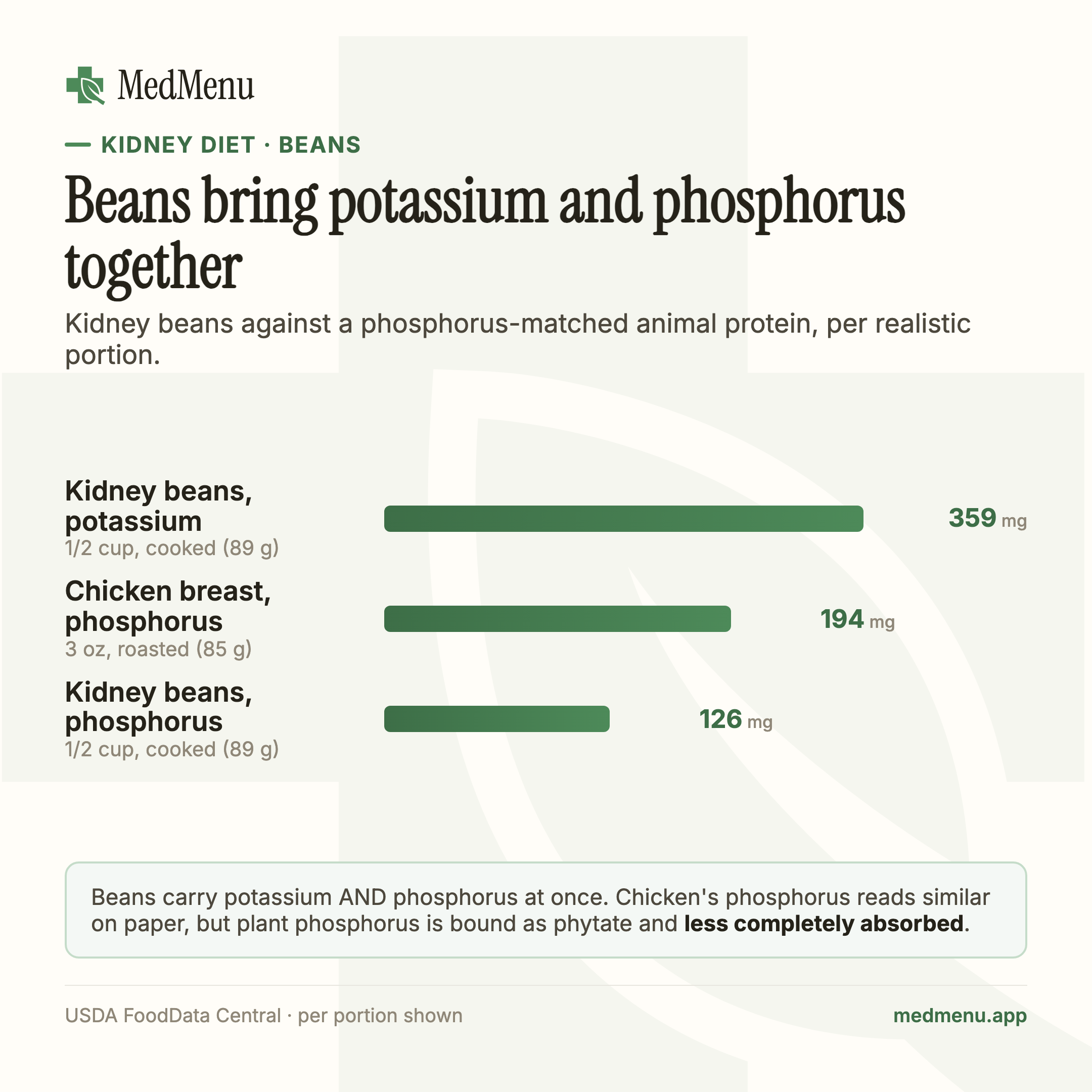
Yes, in a measured portion, and the honest answer runs two directions at once. A half cup of cooked kidney beans carries about 359 mg potassium and 126 mg phosphorus, both minerals a kidney diet typically watches, in the same spoonful. What softens that number is absorption: phosphorus locked inside a plant seed is bound as phytate, and your body does not pull out all of it the way it pulls phosphorus from meat or dairy.
By the MedMenu Editorial Team · Published August 7, 2026
One plant food, two minerals worth watching, set next to a phosphorus-matched animal protein. Per USDA FoodData Central:
| Portion | Potassium | Phosphorus | Carb |
|---|---|---|---|
| Kidney beans, 1/2 cup, cooked (89 g) | 359 mg | 126 mg | 20 g |
| Chicken breast, 3 oz, roasted (85 g) | 218 mg | 194 mg | 0 g |
Matched gram for gram, kidney beans run 403 mg potassium and 142 mg phosphorus per 100 g, real numbers on a plant food most kidney lists mention only in passing. Chicken breast runs lower on potassium (256 mg per 100 g) and higher on phosphorus (228 mg) than beans gram for gram, from a very different kind of food; how chicken itself fits a renal day is covered in can you eat chicken with kidney disease.
Different beans land in different spots. White beans lean harder on potassium, about 505 mg a half cup. Black beans sit closer to even, 305 mg potassium and 120 mg phosphorus a half cup. Kidney beans fall in between, with a real number on both minerals, which is the shape this article is about.
Kidney beans and chicken breast spend their phosphorus differently once you eat them. A bean's phosphorus sits inside the seed as phytate, a storage compound built for germinating a plant rather than for human digestion, and it is not absorbed as completely as the phosphorus in meat, dairy, or a packaged-food additive.
A crossover trial put this to the test directly. Nine people with chronic kidney disease ate a vegetarian protein source for a week and a meat-based diet for another week, both supplying the identical amount of phosphorus. Blood phosphorus and a hormone called FGF23, both markers of phosphorus load, measured lower after the vegetarian week (Moe and colleagues, 2011). It is a small study, so treat the direction as the finding rather than the exact size.
This is why a renal dietitian will portion beans rather than remove them, the same treatment plant proteins get across this whole cluster of articles.
Beans are one of the rarer foods where the diabetes read and the kidney read do not pull against each other the way they do with potatoes or bread. Kidney beans score about 24 on the glycemic index, one of the lowest scores of any starchy food, whole grains included, and a half cup carries fiber alongside its 20 g of carbohydrate.
If you are managing both conditions, beans earn their place on the blood-sugar side of the ledger. The portion is still what decides the mineral side.
Potassium, phosphorus and carbohydrate come from USDA FoodData Central (Standard Reference legacy): kidney beans, cooked, boiled without salt, and chicken breast, meat only, roasted. Glycemic index for kidney beans is cross-checked against published tables (see Sources). For scale, many kidney diets use around 2,000 mg potassium and 1,000 mg phosphorus a day as common reference points, so a half-cup serving of beans is under a fifth of either on its own. There is no single potassium or phosphorus limit that fits everyone; your care team sets yours from your blood test results and CKD stage. Kidney nutrition guidelines put sodium under 2,300 mg a day for most adults; the full 2020 guideline is linked below.
Sources
MedMenu is an information tool, not medical advice, and does not diagnose, treat, or manage any condition. Your nephrologist and renal dietitian set your personal targets from your labs and stage. Published August 7, 2026 · Last updated August 7, 2026.
This is a comprehensive website! Recipes look great and represent a variety of cuisines. You have emphasized the appropriate nutrients. Guidance tips are helpful. Science tab provides evidence-based references and are appropriate for the diseases addressed. Links to Drugs.com, WebMD & Medline are nice. As a registered dietitian, I feel comfortable recommending MedMenu.
Susan G. Rodder, MS, RDN, LD
Registered Dietitian
MedMenu offers all the data you need to plan meals based on specific dietary needs. There are lot of great recipes from a variety of cuisines to choose from, or you can test your own recipe to see how well it fits into your dietary guidelines.
Valerie B.
MedMenu user
Diabetically Speaking with SmartMove360
Both at once, which sets beans apart from a lot of single foods on a kidney list. A half cup of cooked kidney beans carries about 359 mg potassium and 126 mg phosphorus. Most individual foods lean hard toward one mineral or the other; beans carry a real number on each side of the ledger.
Not milligram for milligram. Bean phosphorus is bound as phytate inside the seed and is not absorbed as completely as the phosphorus in meat, dairy, or a packaged-food additive. A small trial in people with kidney disease found lower blood phosphorus after a week on a vegetarian protein source than after a week on meat supplying the identical amount of phosphorus. The milligram count on a label is a starting point, not the full picture.
A half cup, about 359 mg potassium and 126 mg phosphorus, fits most renal daily budgets as a regular portion. There is no single limit that fits everyone; your care team sets yours from your labs and stage.
Rather not count?
A printable week with the potassium, phosphorus and sodium worked out for every meal, so the portions are handled for you.
See the meal plan →