Kidney diet · Phosphorus
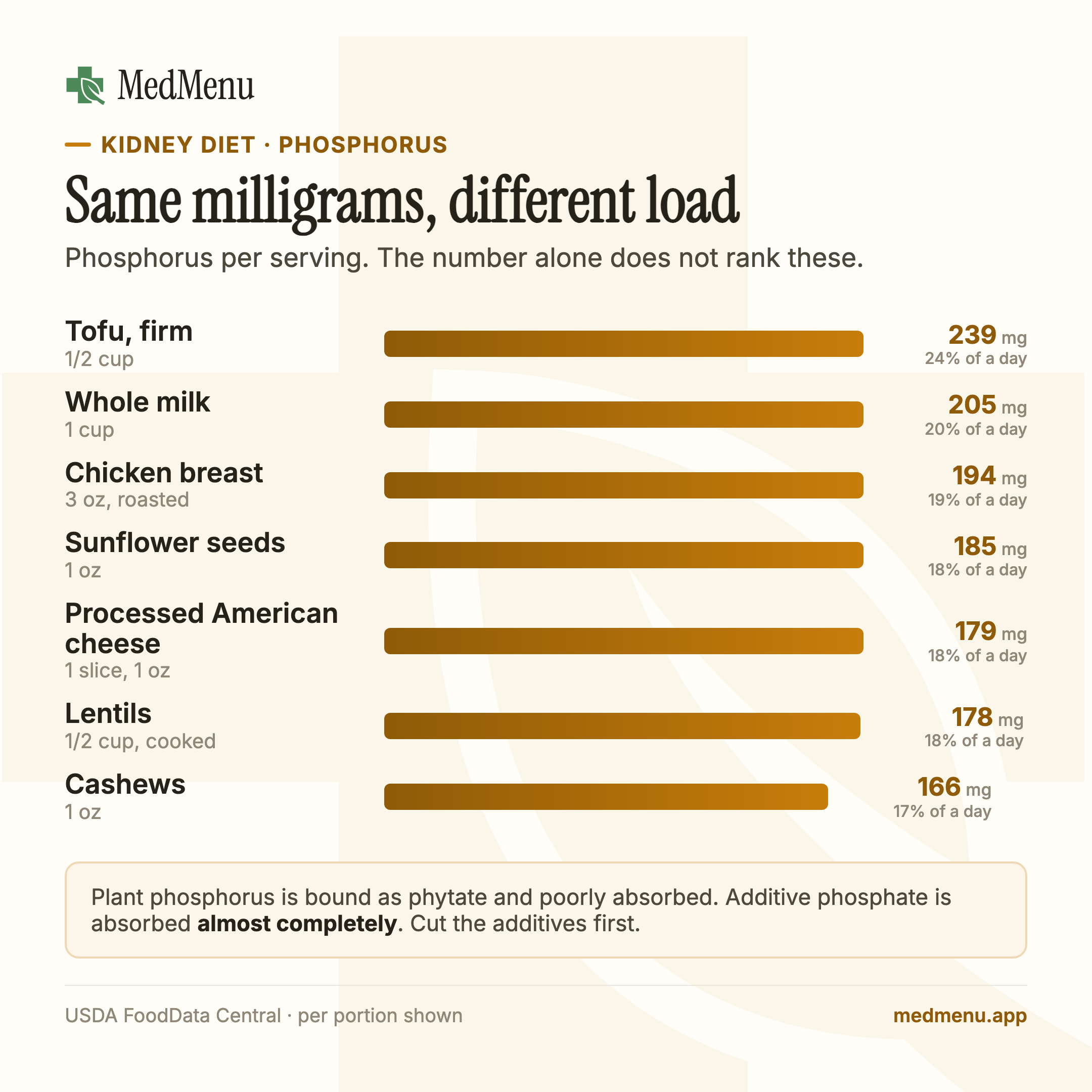
Half a cup of lentils has about 178 mg of phosphorus, and one slice of processed cheese has about 179 mg, the same on paper but not close in your body, because your gut absorbs a small share of the phosphorus in lentils and almost all of the phosphorus added to that cheese slice. Getting this right matters more than shortening your list of foods. The same additive gap shows up inside cheese itself: see natural cheese against a processed slice, ounce for ounce.
By the MedMenu Editorial Team · Published July 21, 2026
Here they are by the milligrams, with where the phosphorus comes from, because that second column changes what the first one means.
| Food | Serving | Phos. mg | Source | Absorption |
|---|---|---|---|---|
| Tofu, firm | 1/2 cup | 239 | Plant | Bound as phytate |
| Whole milk | 1 cup | 205 | Animal | Well absorbed |
| Chicken breast | 3 oz, roasted | 194 | Animal | Well absorbed |
| Sunflower seeds | 1 oz | 185 | Plant | Bound as phytate |
| Processed American cheese | 1 slice, 1 oz | 179 | Additive | Absorbed almost fully |
| Lentils | 1/2 cup, cooked | 178 | Plant | Bound as phytate |
| Cashews | 1 oz | 166 | Plant | Bound as phytate |
| Cheddar cheese | 1 oz | 127 | Animal | Well absorbed |
| Black beans | 1/2 cup, cooked | 120 | Plant | Bound as phytate |
| Beef frankfurter | 1 frankfurter | 67 | Additive | Absorbed almost fully |
| Bologna | 1 slice | 46 | Additive | Absorbed almost fully |
| Cola | 1 can, 12 oz | 33 | Additive | Absorbed almost fully |
| Egg white | 1 large white | 5 | Animal | Lowest on the list |
Renal diets commonly work around 1,000 mg of phosphorus a day as a practical reference, which is common practice rather than a published guideline figure, set from your blood tests and your stage. The Source column describes what is typical for each category rather than a guarantee about a given brand, since added phosphate is not declared on the nutrition panel. The bologna and frankfurter rows are low in milligrams and still worth attention, because processed meats characteristically carry added phosphate.
Because absorption is not a fixed fraction. In plants, most phosphorus is stored as phytate, and humans lack much of the enzyme needed to release it, so a large share travels straight through. In meat and dairy it is bound to proteins that we digest efficiently, so more of it arrives. Additives are not bound to anything at all: they are soluble salts, and they are absorbed almost completely.
The effect has been tested in people. In a small crossover trial in nine patients with chronic kidney disease, one week on a vegetarian protein source produced lower blood phosphorus and lower FGF23 than a meat-based diet containing the same amount of phosphorus (Moe and colleagues, 2011), the same milligrams on paper producing a different result in the blood. It is a small study, so treat it as a strong signal about direction rather than a settled size of effect.
And on the additive side, a randomised trial taught one group of people on dialysis to avoid phosphorus additives while shopping. After three months their serum phosphorus had fallen 0.6 mg/dL further than the group that carried on as before (Sullivan and colleagues, 2009), evidence that reading ingredient lists can move a blood number.
Turn the package over and read the ingredient list, not the nutrition panel. Manufacturers are not required to declare phosphorus on the panel, so a food can be loaded with it and display nothing at all. In the ingredient list the additives announce themselves, as long as you know the tell: any word containing "PHOS".
Where they hide: processed and spreadable cheese, deli meats, chicken and pork labelled "enhanced", "self-basting" or "up to X% solution", colas and some flavoured waters, instant puddings, powdered drink mixes, non-dairy creamers and many frozen convenience meals.
Comparing like with like, these are the places the numbers move most:
For the foods that are low to begin with, and the phosphorus-to-protein ratio that ranks protein foods properly, see the low phosphorus foods list. For foods that keep both minerals down at once, see low potassium and low phosphorus foods.
The phosphorus advice and the blood-sugar advice agree here more than they usually do. Beans, lentils, tofu and nuts, the foods whose phosphorus is least absorbed, are also the lowest-glycemic foods on the plate: half a cup of black beans is 120 mg of phosphorus at a glycemic index of about 30. Keeping them in portions rather than cutting them serves both conditions.
The additive-heavy foods work against both as well. Colas bring phosphate and 38 g of carbohydrate; processed meat and cheese bring phosphate, sodium and saturated fat. Where the two diets genuinely pull apart is starches, worked through in the diabetic kidney disease diet guide.
Phosphorus, potassium and sodium values are from USDA FoodData Central (Standard Reference legacy) for the servings shown, using USDA's own measure weights. The absorption differences are not our estimate: they come from the published work cited above, and the direction of the effect has been measured in people with kidney disease rather than inferred. Because additive content varies by brand and is not on the nutrition panel, treat the ingredient list on the package in front of you as the final word. Renal diets commonly work around 1,000 mg of phosphorus a day as a practical reference, which is common practice rather than a published guideline figure, set from your blood tests and stage.
Sources
MedMenu is an information tool, not medical advice, and does not diagnose, treat, or manage any condition. Your nephrologist and renal dietitian set your personal targets from your labs and stage. Published July 21, 2026 · Last updated July 21, 2026.
This is a comprehensive website! Recipes look great and represent a variety of cuisines. You have emphasized the appropriate nutrients. Guidance tips are helpful. Science tab provides evidence-based references and are appropriate for the diseases addressed. Links to Drugs.com, WebMD & Medline are nice. As a registered dietitian, I feel comfortable recommending MedMenu.
Susan G. Rodder, MS, RDN, LD
Registered Dietitian
MedMenu offers all the data you need to plan meals based on specific dietary needs. There are lot of great recipes from a variety of cuisines to choose from, or you can test your own recipe to see how well it fits into your dietary guidelines.
Valerie B.
MedMenu user
Diabetically Speaking with SmartMove360
By the milligrams alone: dairy, meat, fish, nuts, seeds, beans and whole grains. Half a cup of firm tofu is about 239 mg, a cup of whole milk 205 mg, 3 oz of chicken breast 194 mg, an ounce of sunflower seeds 185 mg. But the milligrams alone are not the whole story, because how much of it your body absorbs depends on where the phosphorus came from.
Yes, and the difference is large enough to matter. In plants much of the phosphorus is stored as phytate, which humans absorb poorly, so a good share of it passes through. In a study of people with chronic kidney disease, one week on a vegetarian source of protein produced lower blood phosphorus and lower FGF23 than the same amount of phosphorus from meat.
They are phosphorus compounds added during manufacturing to preserve, emulsify or improve texture: processed cheese, deli and enhanced meats, colas, instant puddings and many convenience foods. They are not bound to anything, so they are absorbed almost completely. In a randomised trial, teaching people on dialysis to avoid phosphorus additives lowered serum phosphorus by 0.6 mg/dL more than the control group over three months.
Read the ingredient list, not the nutrition panel. Phosphorus is not required on the panel, so a food can be full of it and show nothing. In the ingredient list, look for any word containing PHOS: sodium phosphate, phosphoric acid, sodium tripolyphosphate, dicalcium phosphate, sodium hexametaphosphate. Added phosphate is absorbed far more completely than the phosphorus bound in whole food.
Rather not read every label?
A printable week cooked from whole ingredients, with phosphorus, potassium and sodium counted for every meal.
See the meal plan →