Foods to avoid with kidney disease / Cheese
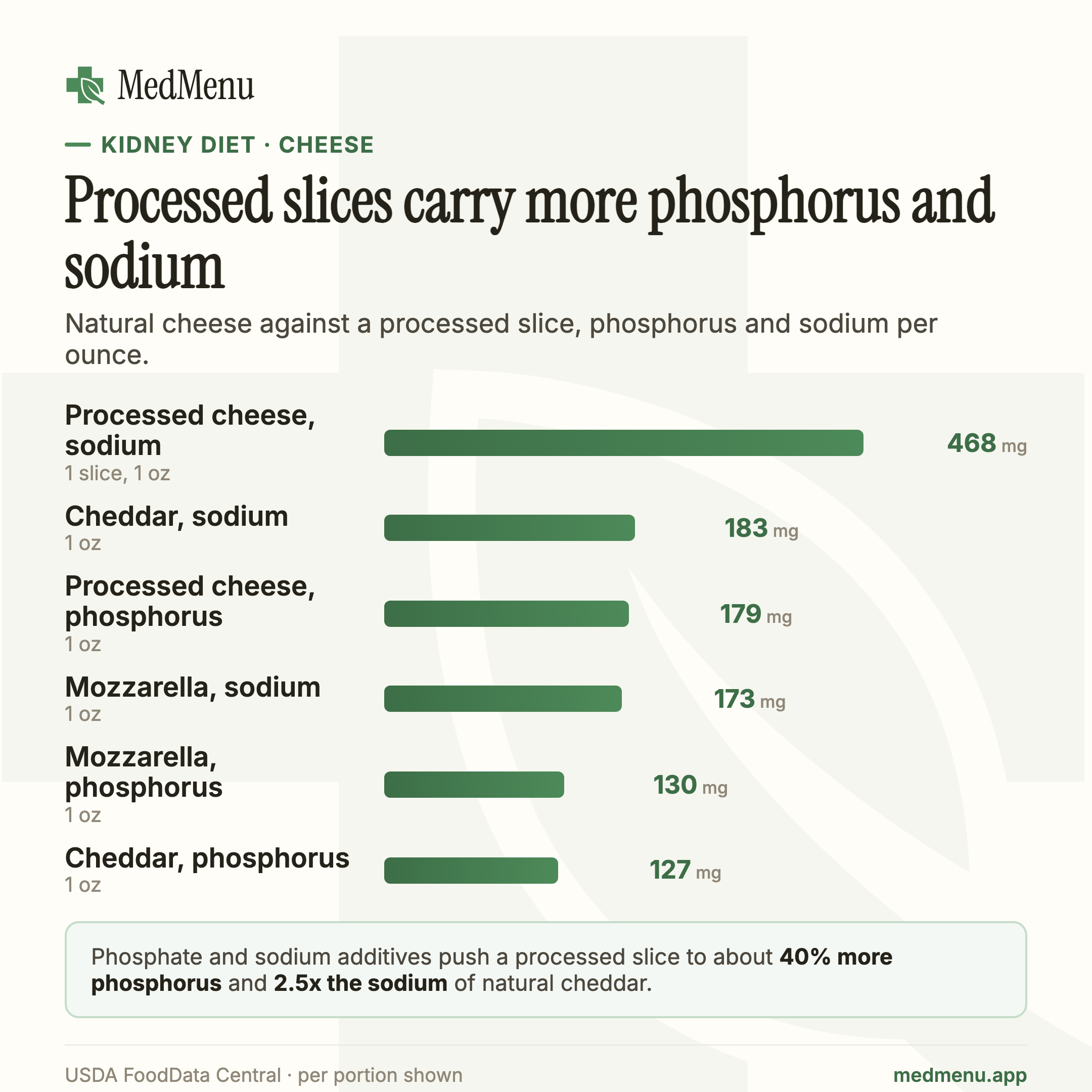
Yes, and the type matters more than the amount. An ounce of natural cheddar or mozzarella carries about 127-130 mg phosphorus and under 185 mg sodium. The same ounce of processed American cheese runs about 179 mg phosphorus and 468 mg sodium, roughly 40% more phosphorus and two and a half times the sodium, for an identical weight. The extra comes from what manufacturing adds.
By the MedMenu Editorial Team · Published August 7, 2026
Two natural cheeses and one processed slice, same weight each time. Mozzarella string cheese is the same part-skim mozzarella as a block, just shaped for snacking. Per USDA FoodData Central:
| Portion | Potassium | Phosphorus | Sodium |
|---|---|---|---|
| Cheddar cheese, 1 oz (28 g) | 21 mg | 127 mg | 183 mg |
| Mozzarella string cheese, 1 oz (28 g) | 24 mg | 130 mg | 173 mg |
| Processed American cheese, 1 slice, 1 oz (28 g) | 37 mg | 179 mg | 468 mg |
The two natural cheeses land within a few milligrams of each other on every column. The processed slice does not: about 1.4 times the phosphorus of cheddar and 2.6 times the sodium, for the identical ounce. Potassium stays low across all three, so potassium is not the number this comparison is about.
Aged cheese varies somewhat by type, so a hard, sharp cheddar and a soft, fresh mozzarella are not identical, but they sit close together next to a processed slice. Cottage cheese and other fresh cheeses run differently again, since they carry more moisture and less concentrated protein per ounce.
Natural cheese is milk, cultures, an enzyme, and salt, aged until the moisture drops and the flavor concentrates. Its phosphorus and sodium come from the milk itself and the salt used in the aging process. Processed cheese starts as shredded natural cheese, then gets remelted with emulsifying salts, usually a form of sodium phosphate, and additional salt so it melts smoothly and holds up on a shelf. Those additions supply the extra phosphorus and most of the extra sodium.
The additive itself matters as much as the amount. Phosphate salts added during processing are absorbed by the body almost completely, out of proportion to how much phosphorus they actually add to the food (Kalantar-Zadeh and colleagues, 2010). In a randomized trial, people on dialysis who were taught to read ingredient lists and avoid phosphorus additives had blood phosphorus fall 0.6 mg/dL further over three months than a group who continued as usual (Sullivan and colleagues, 2009).
This is why a renal dietitian's usual move with cheese is to reach for a natural block or stick over a processed slice when the choice is available, and to check the ingredient list when it is not.
Cheese, natural or processed, carries close to no carbohydrate, so this is one of the rarer foods where the diabetes read does not distinguish between the two forms. The choice between natural and processed is entirely a kidney-side decision.
If you are managing both conditions, cheese stays a reasonable choice in a measured portion; which cheese you reach for changes the phosphorus and sodium load, not the carbohydrate count.
Potassium, phosphorus and sodium come from USDA FoodData Central (Standard Reference legacy): cheddar cheese, mozzarella part-skim milk, and pasteurized process American cheese. For scale, many kidney diets use around 1,000 mg phosphorus and 2,000 mg potassium a day as common reference points, and most adults with kidney disease aim for sodium under 2,300 mg a day, so a processed slice alone is already about a fifth of a full sodium day. There is no single potassium or phosphorus limit that fits everyone; your care team sets yours from your blood test results and CKD stage.
Sources
MedMenu is an information tool, not medical advice, and does not diagnose, treat, or manage any condition. Your nephrologist and renal dietitian set your personal targets from your labs and stage. Published August 7, 2026 · Last updated August 7, 2026.
This is a comprehensive website! Recipes look great and represent a variety of cuisines. You have emphasized the appropriate nutrients. Guidance tips are helpful. Science tab provides evidence-based references and are appropriate for the diseases addressed. Links to Drugs.com, WebMD & Medline are nice. As a registered dietitian, I feel comfortable recommending MedMenu.
Susan G. Rodder, MS, RDN, LD
Registered Dietitian
MedMenu offers all the data you need to plan meals based on specific dietary needs. There are lot of great recipes from a variety of cuisines to choose from, or you can test your own recipe to see how well it fits into your dietary guidelines.
Valerie B.
MedMenu user
Diabetically Speaking with SmartMove360
Yes, for the identical weight. An ounce of cheddar or mozzarella runs about 127-130 mg phosphorus and under 185 mg sodium. An ounce of processed American cheese runs about 179 mg phosphorus, roughly 40% more, and 468 mg sodium, roughly two and a half times as much. The gap comes from manufacturing, not from more cheese in the slice.
Read the ingredient list. Phosphorus does not have to appear as a number on the nutrition panel, so the ingredient names are where added phosphate shows. Look for any ingredient with "phosphate" in the name, such as sodium phosphate, disodium phosphate, or sodium aluminum phosphate. Natural cheddar or mozzarella typically lists milk, cultures, salt, and an enzyme. A processed cheese product usually lists a phosphate salt among its first few ingredients.
An ounce, about the size of a pair of dice, of either cheddar or mozzarella fits most renal daily budgets as a regular portion. There is no single limit that fits everyone; your care team sets yours from your labs and stage.
Rather not count?
A printable week with the potassium, phosphorus and sodium worked out for every meal, so the portions are handled for you.
See the meal plan →