Kidney diet · With diabetes
If you have been handed two sets of instructions that contradict each other, you read them right. Diabetes advice says beans, nuts and whole grains, while kidney advice says white rice and white bread. They disagree on one narrow front, starchy staples and high-fibre plant proteins, and they agree almost everywhere else. Below is exactly where the clash is, with the numbers on both sides, and the foods that satisfy both without you having to pick a condition to disappoint.
By the MedMenu Editorial Team · Published July 21, 2026
These clear every bar at once: a low glycemic index, low potassium and low phosphorus per serving. Glycemic index runs 0 to 100, and 55 or under counts as low.
| Food | Serving | GI | Potas. mg | Phos. mg |
|---|---|---|---|---|
| Egg white | 1 large white | 0 | 54 | 5 |
| Cauliflower | 1/2 cup, cooked | 10 | 88 | 20 |
| Cucumber | 1/2 cup, sliced | 15 | 76 | 12 |
| Green beans | 1/2 cup, cooked | 15 | 99 | 20 |
| Blueberries | 1/2 cup | 53 | 57 | 9 |
| Strawberries | 1/2 cup | 41 | 127 | 20 |
| Sweet cherries | 1/2 cup, pitted | 22 | 171 | 16 |
Egg white is the standout: no effect on blood glucose, 54 mg of potassium and 5 mg of phosphorus, which is why it turns up so often in renal cooking. More options by food group in the low potassium foods list and the vegetable guide.
Because they are optimising for different things. Diabetes advice wants slow carbohydrate, which means fibre, which means whole plants, and those same plants are exactly where potassium and phosphorus concentrate, the two minerals kidney advice wants kept low. So the foods a diabetes educator recommends most warmly are the ones a renal dietitian portions most carefully.
Great for blood sugar, heavy on the minerals:
| Food | Serving | GI | Potas. mg | Phos. mg |
|---|---|---|---|---|
| Lentils | 1/2 cup, cooked | 32 | 365 | 178 |
| White beans | 1/2 cup, cooked | 31 | 505 | 102 |
| Almonds | 1 oz | 0 | 205 | 135 |
| Sweet potato, baked | 1/2 cup, baked | 63 | 475 | 54 |
Kind to the minerals, hard on blood sugar:
| Food | Serving | GI | Potas. mg | Phos. mg |
|---|---|---|---|---|
| White rice | 1/2 cup, cooked | 73 | 28 | 34 |
| White bread | 1 slice | 75 | 32 | 24 |
That is the whole conflict, and it is narrower than it feels at three in the morning. It is two food groups, not your entire diet.
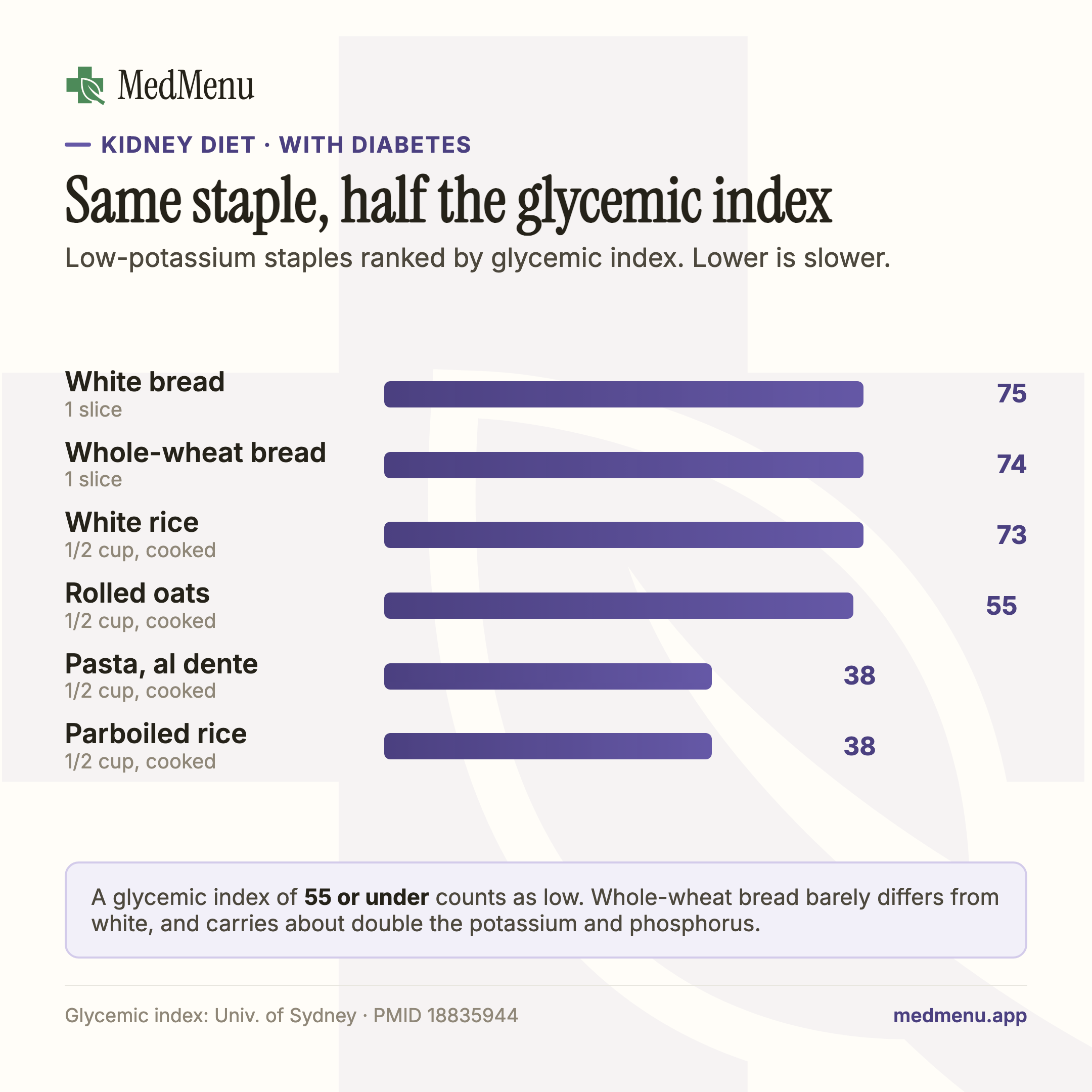
This is the swap almost everyone tries first, and it is the one that pays least. Whole-wheat bread has a glycemic index of about 74. White bread is 75. The blood-sugar difference is close to nothing, because the flour is still finely milled.
Meanwhile the mineral cost is real: per 100 g, whole-wheat bread carries about 254 mg of potassium and 212 mg of phosphorus, against 126 mg and 98 mg for white. You pay double on both minerals and collect almost nothing on glucose.
If bread is what you want, sourdough and multigrain lower the glycemic index more than whole wheat does, at 54 and 53. Their mineral content varies by recipe, so read the label rather than assuming.
Keep the low-potassium grain and change how it behaves, instead of trading it for a high-mineral one. Three that do this well:
| Food | Serving | GI | Potas. mg | Phos. mg |
|---|---|---|---|---|
| Pasta, cooked al dente | 1/2 cup, cooked | 38 | 31 | 41 |
| Parboiled (converted) rice | 1/2 cup, cooked | 38 | 44 | 43 |
| Rolled oats | 1/2 cup, cooked | 55 | 82 | 90 |
Parboiled rice, sold as converted rice, is steamed in the husk before milling, which changes the starch so it digests more slowly. It costs you 16 mg more potassium a half cup than regular white rice and roughly halves the glycemic index. Pasta behaves the same way when it is cooked al dente rather than soft: firm pasta digests slower, and a couple of minutes in the pot is the entire intervention. Rolled oats have the same 55 glycemic index whether they came from a canister or a pot, but see oatmeal and kidney disease for why the instant packet's sodium runs well above a plain bowl's.
Two habits tend to do more than any single swap: a starch portion of about half a cup, and never having it on its own. Protein and non-starchy vegetables on the same plate slow the whole meal down.
One example built only from foods in the tables above, to show the shape rather than to prescribe amounts:
Protein is the piece to settle with your care team rather than a website: kidney guidance generally moderates it when you are not on dialysis, dialysis raises the requirement, and your blood tests decide. What holds either way is measured portions spread across the day.
Potassium and phosphorus come from USDA FoodData Central (Standard Reference legacy) for the portions shown. Glycemic index values come from the University of Sydney database and the published international tables; they are averages from testing in people, so treat them as a ranking rather than a promise about your own glucose. Bread and rice figures are for the specific preparation named, because parboiled, al dente and soft change the result. The daily reference used elsewhere on this site, about 2,000 mg of potassium a day, varies by kidney stage and blood tests, and many people in early stages are not asked to limit potassium at all.
Sources
MedMenu is an information tool, not medical advice, and does not diagnose, treat, or manage any condition. Your nephrologist, diabetes team and renal dietitian set your personal targets from your labs and stage. Published July 21, 2026 · Last updated July 21, 2026.
This is a comprehensive website! Recipes look great and represent a variety of cuisines. You have emphasized the appropriate nutrients. Guidance tips are helpful. Science tab provides evidence-based references and are appropriate for the diseases addressed. Links to Drugs.com, WebMD & Medline are nice. As a registered dietitian, I feel comfortable recommending MedMenu.
Susan G. Rodder, MS, RDN, LD
Registered Dietitian
MedMenu offers all the data you need to plan meals based on specific dietary needs. There are lot of great recipes from a variety of cuisines to choose from, or you can test your own recipe to see how well it fits into your dietary guidelines.
Valerie B.
MedMenu user
Diabetically Speaking with SmartMove360
Build meals from the foods that clear both bars at once: non-starchy vegetables such as cauliflower, green beans and cucumber, egg white and measured portions of lean protein, berries for fruit, and a low-potassium grain cooked for a slower glucose rise, such as pasta cooked al dente or parboiled rice. The conflict is narrow, and it is almost entirely about starchy staples and high-fibre plant proteins.
Because they optimise different things. Diabetes advice pushes fibre-rich whole foods, beans, nuts and whole grains, which are high in potassium and phosphorus. Renal advice pushes refined low-potassium staples such as white rice and white bread, which raise blood sugar fast. Half a cup of lentils is excellent for glucose at a glycemic index of 32, and carries 365 mg of potassium with 178 mg of phosphorus.
Usually not. Whole-wheat bread has a glycemic index of about 74 against 75 for white, so the blood-sugar gain is small, and it carries roughly double the potassium (254 mg per 100 g against 126) and double the phosphorus (212 against 98). Sourdough and multigrain lower the glycemic index more than whole wheat does, though their mineral content varies by recipe.
Rice is one of the lowest-potassium grains, so the question is the blood-sugar side. Regular white rice has a glycemic index of about 73. Parboiled or converted rice comes in near 38 for about 44 mg of potassium a half cup against 28 mg for regular white rice, which is a small mineral cost for a large glycemic gain. See the full rice breakdown for how brown, basmati and wild rice compare.
There is no single number, and this is the one to settle with your care team rather than a website. Kidney guidance for people not on dialysis generally moderates protein, while dialysis raises the requirement, and diabetes affects the picture too. What is consistent: spread protein across the day, keep portions measured, and use your blood tests as the guide.
Keep reading
Low potassium foods list
FruitLow potassium fruits by serving
VegetablesLow potassium vegetables
BreakfastLow potassium breakfast foods
Both mineralsLow potassium and phosphorus
OverviewFoods to avoid with kidney disease
SupplementsIs creatine bad for your kidneys?
SupplementsVitamins for kidney health
Per foodCan you eat avocado with kidney disease?
Plant-basedPlant-based diet and kidney disease
Rather not run two sets of numbers?
A printable week for stage 3 and 4, with sodium, potassium, phosphorus and protein counted for every meal, and the carbohydrate shown alongside.
See the meal plan →