Foods to avoid with kidney disease / Creatine
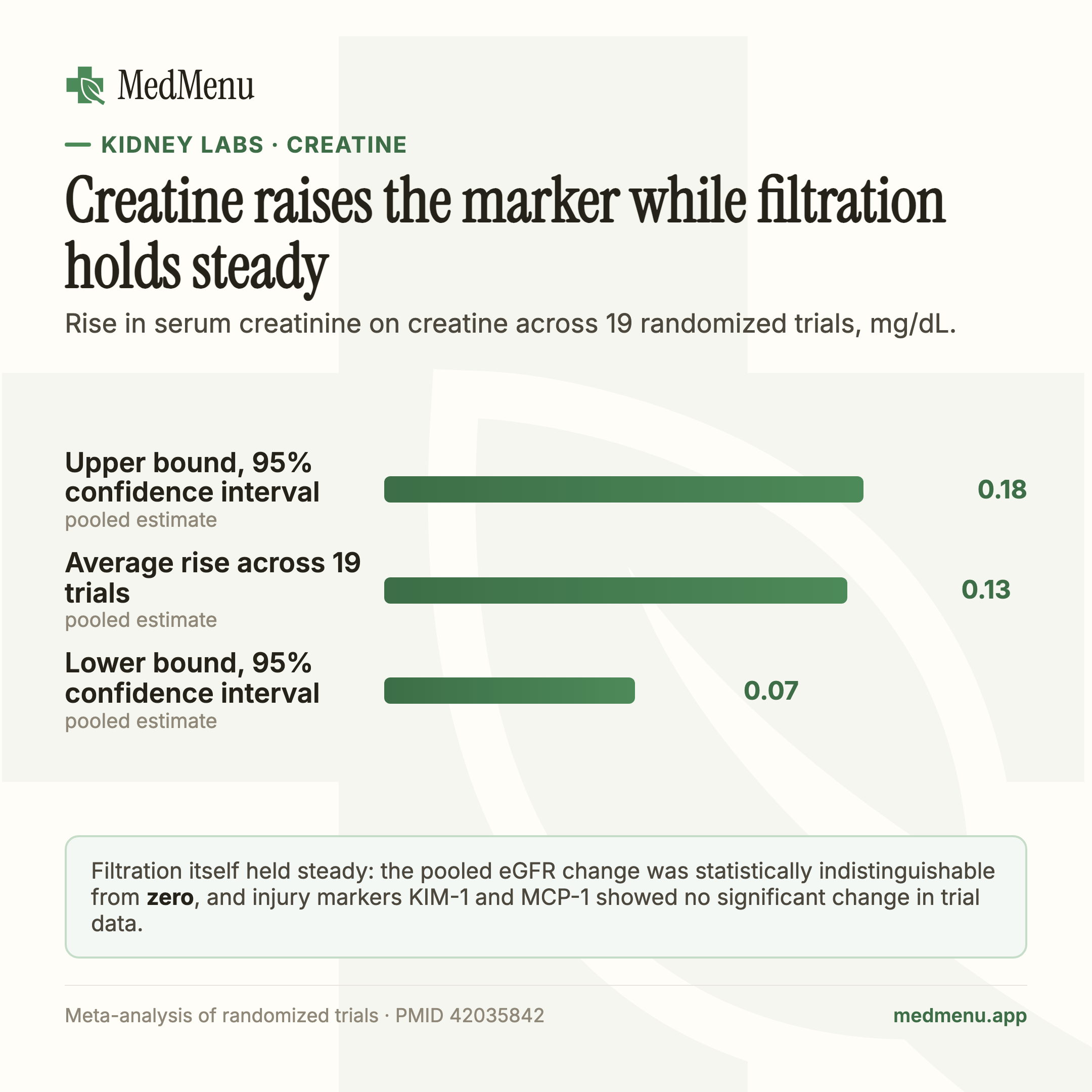
In randomized trials on healthy adults, creatine moved the lab number and left the kidneys alone. Creatinine, the marker on a routine kidney panel, is literally what creatine breaks down into, so supplementing raises it, by an average of 0.13 mg/dL across 19 trials. Measured filtration in those same trials held steady. That gap between the marker and the organ explains most creatine kidney scares. It also has real limits: the trials were short and enrolled healthy people, so if you have diagnosed kidney disease, creatine is a conversation with your nephrologist, and this page is preparation for it rather than a green light.
By the MedMenu Editorial Team · Published August 11, 2026
The two molecules are one step apart. Creatine sits in muscle as a rapid energy reserve, and a small fraction of the body's store breaks down each day into creatinine, which the kidneys clear into urine. Clinicians use blood creatinine as a kidney gauge precisely because that production is usually steady: when the level climbs, the usual reason is that clearance fell.
A supplement breaks that assumption from the production side. More creatine in, more creatinine out, with no change in clearance required. The standard eGFR figure on a lab report is calculated from creatinine, so the same shift flows straight through the equation and the report can read slightly worse while the kidneys filter exactly as before.
The size of the shift has now been pooled across 19 randomized trials: an average rise of 0.13 mg/dL, with a 95% confidence interval of 0.07 to 0.18 (Tsiaras and colleagues, 2026). Muscle gained while training adds its own small contribution, since more muscle produces more creatinine around the clock.
Three independent lines of evidence separate the marker from the organ:
The honest boundary sits in the fine print: every trial above enrolled healthy adults, and the meta-analysis authors themselves call for studies running past a year. Reassurance earned in healthy kidneys does not transfer automatically to compromised ones.
Lead with the disclosure. A clinician reading a kidney panel assumes steady creatinine production; a creatine habit quietly violates that assumption, and the fix is a sentence: "I take creatine." From there the options are theirs, and they are good ones.
If you have diabetes, this arithmetic touches you twice: annual kidney screening in diabetes leans on the same creatinine-based eGFR, so a creatine habit is worth mentioning at every screening, and the combined monitoring picture is part of our diabetic kidney disease diet guide.
Anyone with diagnosed kidney disease, a single kidney, or a history of kidney injury sits outside the trial populations above, and for them the question changes from "does creatine harm healthy kidneys" to "should my kidneys take on any optional load," which only a nephrologist looking at your labs can answer. The same applies to combining creatine with medicines that already tax the kidneys.
Protein from food shapes the same lab work: the by-products of protein metabolism are what kidney diets portion protein to control, a budget worked through in our chicken guide, where a single 3 oz breast covers about two-thirds of a low-protein day.
Every figure comes from the named randomized trials and meta-analysis, each verified live on PubMed before citation, with effect sizes quoted as published. Doses in the cited trials ranged from 3 to roughly 10 g per day, which brackets how creatine is commonly taken. This page reports trial findings in healthy adults; it does not evaluate creatine for any individual, recommend a dose, or apply to diagnosed kidney disease. Your care team interprets your labs.
Sources
MedMenu is an information tool, not medical advice, and does not diagnose, treat, or manage any condition. Your nephrologist and renal dietitian set your personal targets from your labs and stage. Published August 11, 2026 · Last updated August 11, 2026.
This is a comprehensive website! Recipes look great and represent a variety of cuisines. You have emphasized the appropriate nutrients. Guidance tips are helpful. Science tab provides evidence-based references and are appropriate for the diseases addressed. Links to Drugs.com, WebMD & Medline are nice. As a registered dietitian, I feel comfortable recommending MedMenu.
Susan G. Rodder, MS, RDN, LD
Registered Dietitian
MedMenu offers all the data you need to plan meals based on specific dietary needs. There are lot of great recipes from a variety of cuisines to choose from, or you can test your own recipe to see how well it fits into your dietary guidelines.
Valerie B.
MedMenu user
Diabetically Speaking with SmartMove360
Yes, by a small and expected amount. Creatinine is what creatine breaks down into, so adding creatine adds creatinine. Across 19 randomized trials, supplementation raised serum creatinine by an average of 0.13 mg/dL. Because the standard eGFR estimate is calculated from creatinine, that rise can make a routine kidney panel read slightly worse without any change in what the kidneys are doing.
Randomized trials in healthy adults have repeatedly found no change in measured kidney function. The pooled eGFR change across trials was statistically indistinguishable from zero, a three-month trial at about 10 g a day found the creatine-independent marker cystatin C stayed normal, and a trial at everyday doses of 3 to 5 g a day found kidney-injury markers KIM-1 and MCP-1 unchanged. The honest limits: these trials ran a year or less and enrolled healthy people. For anyone with diagnosed kidney disease, creatine is a decision to make with a nephrologist, and this article is information rather than clearance.
Tell the clinician who ordered the test that you take creatine, and let them decide. Because creatine raises creatinine on its own, they may interpret the result differently or use a cystatin C-based estimate, which ignores creatine intake entirely. Adjusting supplements or medicines around a test on your own can hide information your care team wants to see.
Rather not count?
A printable week with the protein, potassium, phosphorus and sodium worked out for every meal, so the portions are handled for you.
See the meal plan →