Foods to avoid with kidney disease / Collagen
Collagen peptides carry almost no potassium or phosphorus per scoop, a genuinely different mineral profile from whey or soy protein powder. That part is reassuring. Two other things about collagen are less simple: it is missing an essential amino acid, so its protein grams still count fully against a kidney diet's tight protein ceiling for less nutritional return, and its unusual amino acid makeup raises urinary oxalate, a kidney-stone risk factor that has nothing to do with potassium or phosphorus.
By the MedMenu Editorial Team · Published August 24, 2026
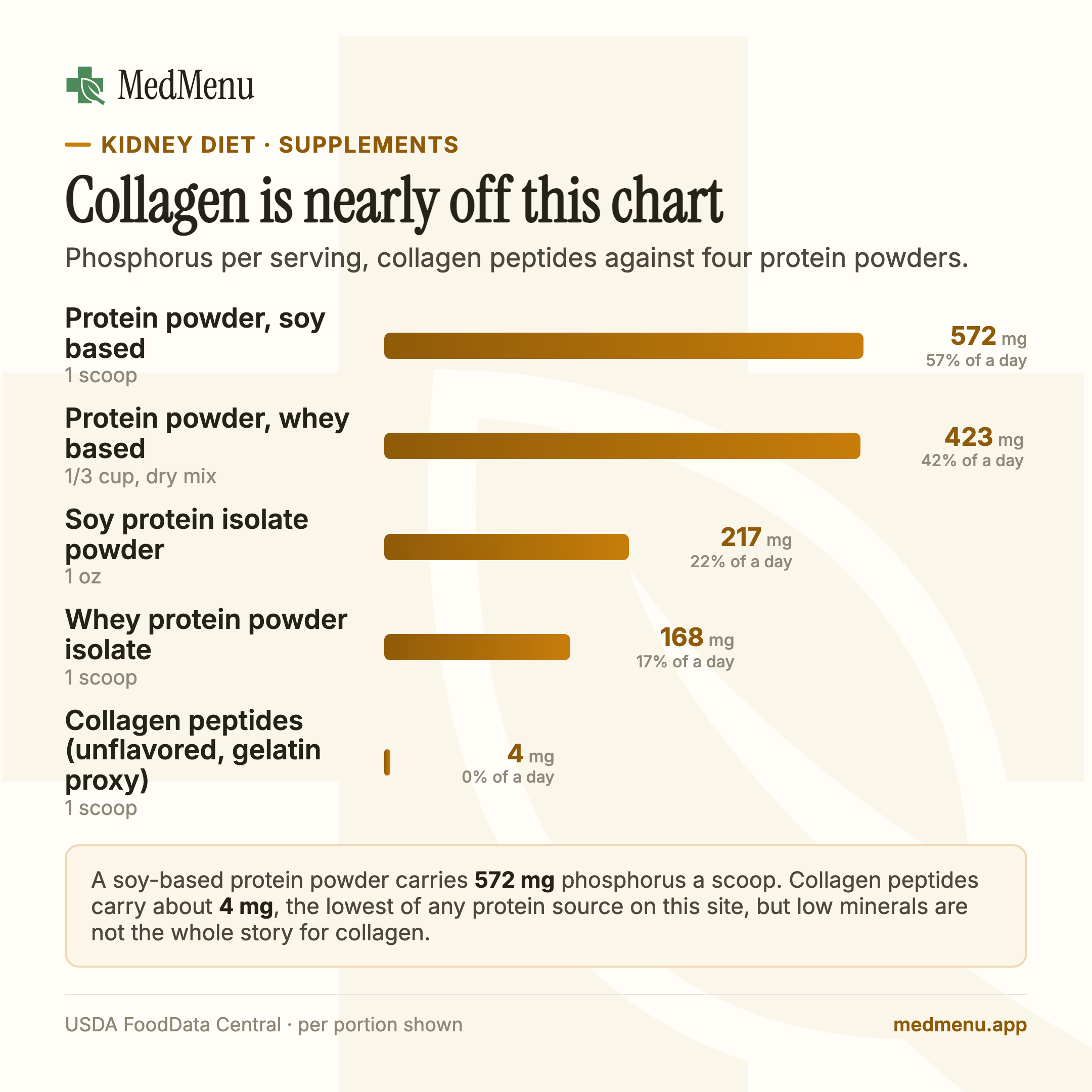
Per USDA FoodData Central, a 10 gram scoop of collagen peptides (the closest tracked entry is unflavored dry gelatin powder, made from the same source protein and sharing its amino acid profile) carries about 4 mg phosphorus and 2 mg potassium. That is far below every protein powder formulation already on this site, and well below a chicken breast of similar protein output.
| Portion | Protein | Phosphorus | Potassium | Sodium |
|---|---|---|---|---|
| Collagen peptides, 1 scoop (10 g) | 9 g | 4 mg | 2 mg | 20 mg |
| Protein powder, soy based, 1 scoop (45 g) | 25 g | 572 mg | 420 mg | 330 mg |
| Protein powder, whey based, 1/3 cup (32 g) | 25 g | 423 mg | 160 mg | 50 mg |
| Soy protein isolate powder, 1 oz (28 g) | 25 g | 217 mg | 23 mg | 281 mg |
| Whey protein powder isolate, 1 scoop (29 g) | 17 g | 168 mg | 253 mg | 108 mg |
| Chicken breast, 3 oz, roasted (85 g) | 26 g | 194 mg | 218 mg | 63 mg |
A common working reference for phosphorus on a kidney diet is around 1,000 mg a day, set from your own labs and stage rather than a universal cutoff.
Even doubled to a 20 gram serving, collagen's phosphorus stays under 10 mg, still the lowest number on this table by a wide margin. Sodium is the one exception worth a second look: at 196 mg per 100 g, collagen's sodium runs higher than the whey-based powder's, though a single scoop still lands well under a chicken breast's sodium. The comparison below explains why collagen's low mineral count is not the whole story. For more whole-food protein options at this end of the scale, see our phosphorus in protein foods, ranked comparison.
The main clinical nutrition guideline for kidney disease recommends about 0.55 to 0.6 grams of protein per kilogram of body weight a day for adults with CKD stage 3 to 5 who do not have diabetes, or 0.6 to 0.8 grams per kilogram where diabetes is also present, both under a doctor's supervision (Ikizler and colleagues, 2020). For a 70 kilogram (about 154 lb) adult, that works out to roughly 39 to 42 grams of protein a day without diabetes, or 42 to 56 grams with it, counting every source together, food and supplements combined. A single 10 gram scoop of collagen adds about 9 grams toward that ceiling.
Here is the part the low mineral count hides: collagen is missing the essential amino acid tryptophan entirely, and it scores low on PDCAAS, the standard method for comparing protein quality across foods, making it an incomplete protein (Paul and colleagues, 2019). That same research found up to 36% of dietary protein in a typical diet could be replaced with collagen peptides while still meeting essential amino acid needs, a figure modeled for a general diet rather than tested against the far tighter protein ceiling the kidney guideline sets. A kidney diet's protein budget counts every gram the same regardless of quality, so a gram spent on an incomplete protein is a gram not available for a complete one, whether that is chicken, egg, fish, or a whey-based powder.
If collagen is part of your routine and you have CKD, naming it to your nephrologist or renal dietitian, and asking how it fits your specific protein target, is the plain next step.
Possibly, through a pathway that has nothing to do with potassium or phosphorus. Gelatin and hydrolyzed collagen peptides come from the same source protein and share an amino acid makeup that is unusual among proteins: a large share of it is hydroxyproline, a building block the body can convert into oxalate. In a controlled feeding study, a 30 gram gelatin dose raised urinary oxalate excretion 43% and urinary glycolate excretion more than fivefold compared with an equal 30 gram dose of whey protein on the same controlled diet, and the rise showed up at gelatin doses of 5 to 10 grams but not at 1 to 2 grams (Knight and colleagues, 2006). Commercial collagen peptide products are typically dosed in a 2.5 to 15 gram daily range, a window that overlaps the doses where this study measured the rise.
Higher urinary oxalate is a known risk factor for calcium oxalate stones, the most common type of kidney stone. This study measured oxalate and glycolate output during a controlled feeding period, not stone formation itself, and it tested gelatin rather than a modern hydrolyzed collagen peptide supplement, so read it as the closest available evidence on this mechanism rather than a direct trial of collagen products. Anyone with a personal or family history of calcium oxalate stones, a group that can overlap with CKD, is where this finding carries the most weight, and no kidney nutrition guideline currently sets a specific collagen dose for that situation.
Collagen carries no carbohydrate, so it will not move blood sugar the way a sweetened drink or juice would. If you are managing both diabetes and kidney disease, our diabetic kidney disease diet guide covers the food targets that do move together.
Phosphorus, potassium, sodium and protein figures for collagen peptides, the four protein powders and chicken breast come from USDA FoodData Central (Standard Reference legacy), the same spine used across this site's kidney articles; collagen peptides has no dedicated USDA entry, so the closest deliberately chosen proxy is unflavored dry gelatin powder, named as such rather than left implicit. The hydroxyproline-oxalate finding, the protein-quality finding, and the guideline's protein ceiling are each cited at the level their published abstracts support; none gives a number this page does not state. This page names no dose or target to follow: your nephrologist and renal dietitian are the right people to set your protein target and weigh a collagen supplement against your labs and stone history.
Sources
MedMenu is an information tool, not medical advice, and does not diagnose, treat, or manage any condition. Your nephrologist and renal dietitian set your personal protein target and weigh any supplement against your labs and stage. Published August 24, 2026 · Last updated August 24, 2026.
This is a comprehensive website! Recipes look great and represent a variety of cuisines. You have emphasized the appropriate nutrients. Guidance tips are helpful. Science tab provides evidence-based references and are appropriate for the diseases addressed. Links to Drugs.com, WebMD & Medline are nice. As a registered dietitian, I feel comfortable recommending MedMenu.
Susan G. Rodder, MS, RDN, LD
Registered Dietitian
MedMenu offers all the data you need to plan meals based on specific dietary needs. There are lot of great recipes from a variety of cuisines to choose from, or you can test your own recipe to see how well it fits into your dietary guidelines.
Valerie B.
MedMenu user
Diabetically Speaking with SmartMove360
Collagen peptides carry very little potassium or phosphorus, far less than whey or soy protein powders. But collagen is still a concentrated protein that counts against a kidney diet's protein ceiling, and it is missing the essential amino acid tryptophan, making it a lower-quality protein gram for gram than a complete source. Its high hydroxyproline content also raises urinary oxalate, a separate risk factor for kidney stones, in a controlled feeding study.
The main clinical nutrition guideline for kidney disease recommends about 0.55 to 0.6 grams of protein per kilogram of body weight a day for adults with CKD stage 3 to 5 without diabetes, or 0.6 to 0.8 grams per kilogram with diabetes, under a doctor's supervision. For a 70 kilogram adult, that is roughly 39 to 42 grams a day without diabetes, or 42 to 56 grams with it, from every source combined. A 10 gram scoop of collagen adds about 9 grams toward that ceiling, and because collagen lacks tryptophan and scores low on standard protein-quality measures, those 9 grams do less nutritional work than the same amount from a complete protein.
Possibly. Gelatin and collagen peptides share the same source protein and an unusually high content of hydroxyproline, an amino acid the body can convert to oxalate. A controlled feeding study found a 30 gram gelatin dose raised urinary oxalate excretion 43% and glycolate excretion over fivefold compared with an equal dose of whey protein, with the effect appearing at 5 to 10 gram doses. Higher urinary oxalate is a known risk factor for calcium oxalate kidney stones, the most common type.
Rather not count?
A printable week with the protein sources and their phosphorus, potassium and sodium already worked out for every meal.
See the meal plan →