Kidney diet · Statistics · Protein
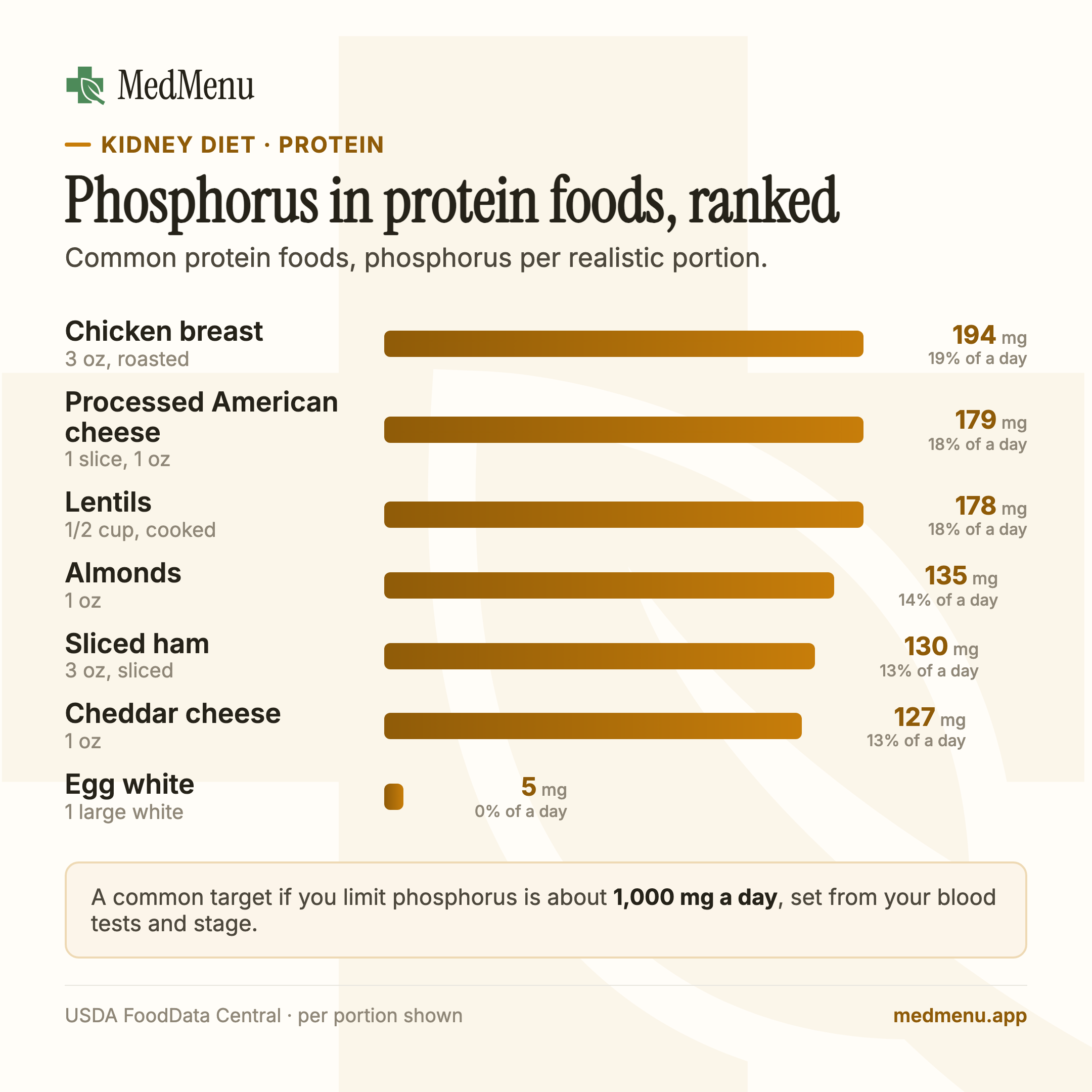
Egg white carries about 5 mg of phosphorus a serving, the lowest of any protein food audited here. Firm tofu carries the most, about 239 mg for a half cup. Between them sit chicken, beans, cheese, nuts and processed meat, each with its own number below, sourced to USDA FoodData Central and shown alongside potassium and sodium for the same portion.
By the MedMenu Editorial Team · Published August 15, 2026
Cite this data
Every figure below traces to USDA FoodData Central. If you reference a number from this table, use the box below to credit it.
MedMenu. "Phosphorus in Protein Foods, Ranked by Portion." 2026. https://medmenu.app/eat-well/phosphorus-in-protein-foods. Data: USDA FoodData Central, Standard Reference Legacy.
Milligrams of phosphorus in a realistic serving:
For scale, many kidney diets work around 1,000 mg of phosphorus a day as a practical reference, set from your blood tests and CKD stage, not a single published number that fits everyone.
Ranked low to high, with potassium and sodium shown for the same portion, since a protein choice that helps one mineral can work against another.
| Food | Portion | Phosphorus mg | Potassium mg | Sodium mg | Protein g |
|---|---|---|---|---|---|
| Egg white | 1 large white (33 g) | 5 | 54 | 55 | 4 |
| Bologna | 1 slice (30 g) | 46 | 105 | 304 | 3 |
| Egg yolk | 1 large yolk (17 g) | 66 | 19 | 8 | 3 |
| Beef frankfurter | 1 frankfurter (48 g) | 67 | 121 | 409 | 6 |
| Green peas, raw | 1/2 cup (73 g) | 79 | 178 | 4 | 4 |
| Egg | 1 large (50 g) | 86 | 63 | 62 | 6 |
| Green peas, boiled | 1/2 cup (80 g) | 94 | 217 | 2 | 4 |
| White beans | 1/2 cup, cooked (90 g) | 102 | 505 | 5 | 9 |
| Peanut butter | 2 tbsp (32 g) | 107 | 179 | 5 | 7 |
| Black beans | 1/2 cup, cooked (86 g) | 120 | 305 | 1 | 8 |
| Kidney beans | 1/2 cup, cooked (89 g) | 126 | 359 | 2 | 8 |
| Cheddar cheese | 1 oz (28 g) | 127 | 21 | 183 | 6 |
| Mozzarella string cheese | 1 stick, 1 oz (28 g) | 130 | 24 | 173 | 7 |
| Sliced ham | 3 oz, sliced (85 g) | 130 | 244 | 692 | 14 |
| Almonds | 1 oz (28 g) | 135 | 205 | 0 | 6 |
| Cashews | 1 oz (28 g) | 166 | 185 | 3 | 5 |
| Cottage cheese, 2% | 1/2 cup (113 g) | 170 | 141 | 348 | 12 |
| Chicken thigh with added solution | 3 oz, roasted, meat only (85 g) | 172 | 228 | 150 | 21 |
| Lentils | 1/2 cup, cooked (99 g) | 178 | 365 | 2 | 9 |
| Processed American cheese | 1 slice, 1 oz (28 g) | 179 | 37 | 468 | 5 |
| Chicken thigh with skin | 3 oz, roasted, meat and skin (85 g) | 184 | 215 | 87 | 20 |
| Sunflower seeds | 1 oz (28 g) | 185 | 181 | 3 | 6 |
| Chicken breast | 3 oz, roasted (85 g) | 194 | 218 | 63 | 26 |
| Chicken thigh | 3 oz, roasted, meat only (85 g) | 196 | 229 | 90 | 21 |
| Whole milk | 1 cup (244 g) | 205 | 322 | 105 | 8 |
| Deli chicken breast | 3 oz, sliced (85 g) | 218 | 306 | 877 | 15 |
| Tofu, firm | 1/2 cup (126 g) | 239 | 299 | 18 | 22 |
27 protein foods, spanning egg, dairy, poultry, processed meat, legume, nut and soy sources. Green marks the lowest phosphorus rows, amber the highest phosphorus or sodium rows.
No single category wins outright. Egg white sits at the very bottom because most of an egg's phosphorus concentrates in the yolk. Poultry runs in the middle, roughly 170 to 220 mg for a 3-ounce portion, with skin and added-solution products pushing toward the higher end. Legumes (beans, lentils, peas) land in a similar middle band on phosphorus, but carry meaningfully more potassium per portion than poultry does. Dairy spans the widest range of any category here: cottage cheese and whole milk sit mid-table, while firm tofu, technically a soy curd rather than dairy, tops the whole list.
Not all phosphorus behaves the same once it is inside the body. A significant share of the phosphorus in beans and lentils is bound as phytate, which the human gut absorbs poorly. A small crossover trial in nine people with CKD found lower serum phosphorus after a week of vegetarian protein sources than after a week of meat protein carrying the same phosphorus content on paper (Moe et al., 2011). The milligram figure in the table is the total phosphorus content; how much of it your body actually takes up depends partly on the source.
Often, yes, and the phosphorus number alone can miss it. Deli chicken breast, sliced ham, processed American cheese and chicken with added solution all carry an additive: inorganic phosphate, which is absorbed far more completely than the phosphorus naturally present in whole food (Kalantar-Zadeh et al., 2010). The same processing usually adds sodium alongside it: deli chicken breast carries 877 mg of sodium in a 3-ounce portion, more than a third of a full day's reference intake, and processed cheese runs 468 mg against natural cheddar's 183. Reading only the phosphorus column would miss that second cost entirely.
This is why the table above keeps sodium visible next to phosphorus rather than treating them as separate lists. A food that looks moderate on one mineral can still be a poor overall choice once the other is counted.
Most animal proteins in this table carry close to zero carbohydrate. The legumes are the exception: a half cup of white beans, black beans, kidney beans or lentils runs 20 to 23 g of carbohydrate, and boiled green peas about 13 g, alongside their phosphorus and potassium numbers. That carbohydrate is real and worth counting on a diabetes meal plan, even though beans and lentils are otherwise a lower-glycemic choice than refined starches.
Every value is from USDA FoodData Central (Standard Reference legacy), for the exact preparation named in each row. Serving sizes are USDA's own household measure weights for that food, not a generic 100-gram serving. Nothing on this page is hand-typed or estimated; every row is pulled directly from the same audited data file behind MedMenu's other kidney content, so a figure here always matches the same food's figure anywhere else on the site.
Sources
Not medical advice. MedMenu helps you find food choices that align with published dietary guidelines; every figure above shows its source, and none of it replaces your care team. There is no single phosphorus, potassium or sodium limit that fits everyone; your nephrologist or renal dietitian sets yours from your CKD stage and blood test results. Published August 15, 2026 · Last updated August 15, 2026.
This is a comprehensive website! Recipes look great and represent a variety of cuisines. You have emphasized the appropriate nutrients. Guidance tips are helpful. Science tab provides evidence-based references and are appropriate for the diseases addressed. Links to Drugs.com, WebMD & Medline are nice. As a registered dietitian, I feel comfortable recommending MedMenu.
Susan G. Rodder, MS, RDN, LD
Registered Dietitian
MedMenu offers all the data you need to plan meals based on specific dietary needs. There are lot of great recipes from a variety of cuisines to choose from, or you can test your own recipe to see how well it fits into your dietary guidelines.
Valerie B.
MedMenu user
Diabetically Speaking with SmartMove360
Egg white, at about 5 mg per large white, the lowest of any protein food in this table. Beef frankfurter and egg yolk sit next, both around 66 to 67 mg.
Firm tofu, at about 239 mg per half cup, the highest in this table. Deli chicken breast and whole milk follow, at about 218 and 205 mg.
No. A significant share of the phosphorus in beans, lentils and other legumes is bound as phytate, which the human gut absorbs poorly. A small crossover trial in people with CKD found lower serum phosphorus on a week of vegetarian protein than a week of meat protein carrying the same phosphorus content (Moe et al., 2011).
Often, yes. Deli chicken breast, ham, processed cheese and chicken with added solution carry both added phosphate and meaningfully more sodium than their unprocessed counterparts, sometimes several hundred milligrams of sodium in a single serving.
Rather not count?
A printable week where the protein sources and their phosphorus, potassium and sodium are already counted for every meal.
See the meal plan →