Foods to avoid with kidney disease / Eggs
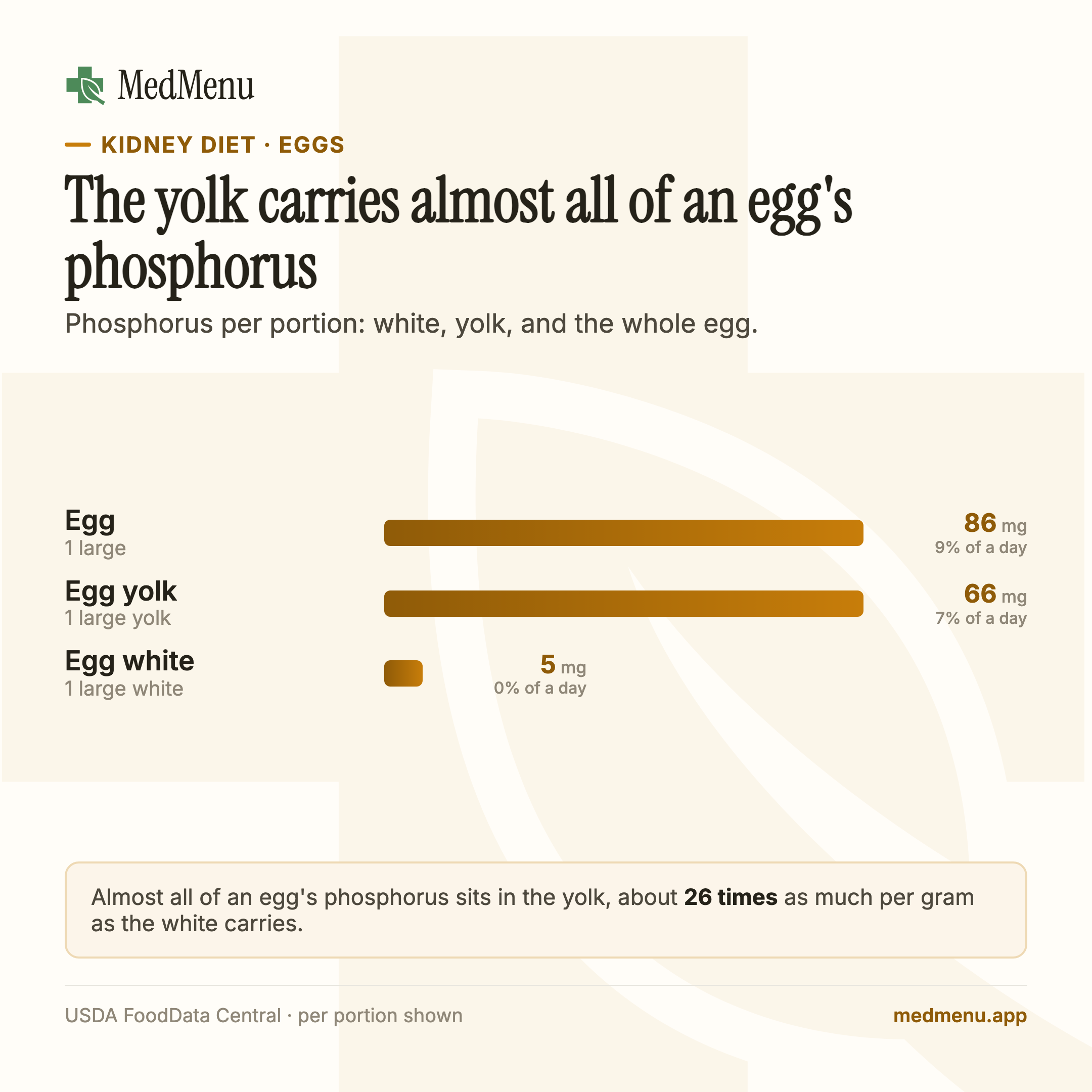
Yes, and an egg is really two foods sharing a shell. A large egg white carries about 5 mg phosphorus and no carbohydrate, close to as clean a protein as exists on a kidney list. A single yolk carries about 66 mg, close to all of the whole egg's roughly 86 mg. Both numbers point to portioning the yolk the way you would any phosphorus-carrying food, not avoiding it.
By the MedMenu Editorial Team · Published August 7, 2026
Three forms, the same food. Per USDA FoodData Central:
| Portion | Potassium | Phosphorus | Carb |
|---|---|---|---|
| Egg white, 1 large (33 g) | 54 mg | 5 mg | 0 g |
| Egg yolk, 1 large (17 g) | 19 mg | 66 mg | 1 g |
| Whole egg, 1 large, hard-boiled (50 g) | 63 mg | 86 mg | 1 g |
Matched gram for gram, egg yolk runs about 390 mg phosphorus per 100 g against 15 mg for egg white, roughly a 26-fold gap. Potassium runs the other way in a portion: a white (54 mg) carries almost three times what a yolk (19 mg) does, so the split is specifically a phosphorus story, not a story about every mineral moving together.
Cooking method barely moves the split. Scrambled, fried, poached, or hard-boiled, the phosphorus stays with the yolk; what changes the total is what gets added to the pan, cheese, milk, or butter, not the egg itself.
An egg is really two separate foods stapled together by a shell. The white is close to pure protein and water. The yolk carries the fat and most of the vitamins and minerals, phosphorus included, which is why the USDA figures above run so far apart: about 390 mg phosphorus per 100 g of yolk against 15 mg per 100 g of white.
Egg yolk phosphorus counts close to its full milligram value, unlike some plant phosphorus that earns a partial discount. Researchers who study dietary phosphorus sources sort it by how completely the body absorbs it: phosphorus bound as phytate in seeds and legumes is less bioavailable, while phosphate additives in processed and preserved foods are absorbed almost completely, out of proportion to how much of the food's total phosphorus they represent (Kalantar-Zadeh and colleagues, 2010). Egg yolk phosphorus occurs naturally in an animal food, placing it in neither category: it skips the plant discount and skips the additive's outsized absorption, landing at its stated value.
This is why a renal dietitian's usual move with eggs keeps the yolk in the dish, just weighted toward whites: a scramble built mostly from whites with one whole egg folded in for flavor rather than three or four whole eggs.
Eggs, in any form on this page, carry 0 to 1 g of carbohydrate a serving, so they do not move blood sugar the way a starch does. That makes an egg-based breakfast close to a free choice on the glucose side, whatever the kidney-side portioning looks like.
If you are managing both conditions, eggs are one of the rarer foods where the diabetes read is simple, and the kidney read is what still needs a portion decision.
Potassium, phosphorus and carbohydrate come from USDA FoodData Central (Standard Reference legacy): egg white and egg yolk, raw and fresh, and a whole egg, cooked and hard-boiled. For scale, many kidney diets use around 2,000 mg potassium and 1,000 mg phosphorus a day as common reference points, so even the whole-egg row is under a tenth of either on its own. There is no single potassium or phosphorus limit that fits everyone; your care team sets yours from your blood test results and CKD stage. Kidney nutrition guidelines put sodium under 2,300 mg a day for most adults; the full 2020 guideline is linked below.
Sources
MedMenu is an information tool, not medical advice, and does not diagnose, treat, or manage any condition. Your nephrologist and renal dietitian set your personal targets from your labs and stage. Published August 7, 2026 · Last updated August 7, 2026.
This is a comprehensive website! Recipes look great and represent a variety of cuisines. You have emphasized the appropriate nutrients. Guidance tips are helpful. Science tab provides evidence-based references and are appropriate for the diseases addressed. Links to Drugs.com, WebMD & Medline are nice. As a registered dietitian, I feel comfortable recommending MedMenu.
Susan G. Rodder, MS, RDN, LD
Registered Dietitian
MedMenu offers all the data you need to plan meals based on specific dietary needs. There are lot of great recipes from a variety of cuisines to choose from, or you can test your own recipe to see how well it fits into your dietary guidelines.
Valerie B.
MedMenu user
Diabetically Speaking with SmartMove360
Mostly the yolk. A single large yolk carries about 66 mg phosphorus, close to all of a whole egg's roughly 86 mg. A large white carries about 5 mg. Gram for gram the gap is even larger: about 390 mg phosphorus per 100 g of yolk against 15 mg per 100 g of white, roughly a 26-fold difference.
No single rule fits everyone. Whole eggs and yolks fit a kidney diet in a measured portion, the same as beans, chicken, or cheese do. A common approach in renal cooking weights a dish toward whites, for example a scramble built mostly from whites with one whole egg folded in for flavor, rather than removing yolks entirely.
A whole egg (about 86 mg phosphorus, 63 mg potassium) or two egg whites (about 10 mg phosphorus, 108 mg potassium combined) both fit most renal daily budgets as a regular serving. There is no single limit that fits everyone; your care team sets yours from your labs and stage.
Rather not count?
A printable week with the potassium, phosphorus and sodium worked out for every meal, so the portions are handled for you.
See the meal plan →