Foods to avoid with kidney disease / Vitamin D
Your kidneys activate vitamin D, they don't just clear it. A second conversion step, the one that turns the vitamin D your body stores into the hormone it actually uses, happens in the kidney. Declining kidney function is a documented cause of running low on vitamin D, even when diet and sun exposure haven't changed. Correcting that shortage is a real trade-off, one worth working out with your nephrologist from your labs.
By the MedMenu Editorial Team · Published August 17, 2026
Sunlight and food supply what's called storage vitamin D, 25-hydroxyvitamin D, the form a standard blood test measures. On its own, that form does very little. The kidney runs a second hydroxylation reaction that converts it into 1,25-dihydroxyvitamin D, also called calcitriol, the hormone that actually does the work of managing calcium and bone. That final activation step happens in the kidney and nowhere else in most adults.
As kidney function declines, that step is one of the first things to weaken, even in someone whose diet and sun exposure haven't changed. A 2018 review put the scale of it plainly: vitamin D deficiency prevalence in chronic kidney disease has been reported to be as high as 80% (Franca Gois and colleagues, 2018). The same review is direct about the limits of the evidence: current guidelines that recommend supplementing vitamin D in CKD extrapolate from studies done in the general population, not CKD-specific outcome trials.
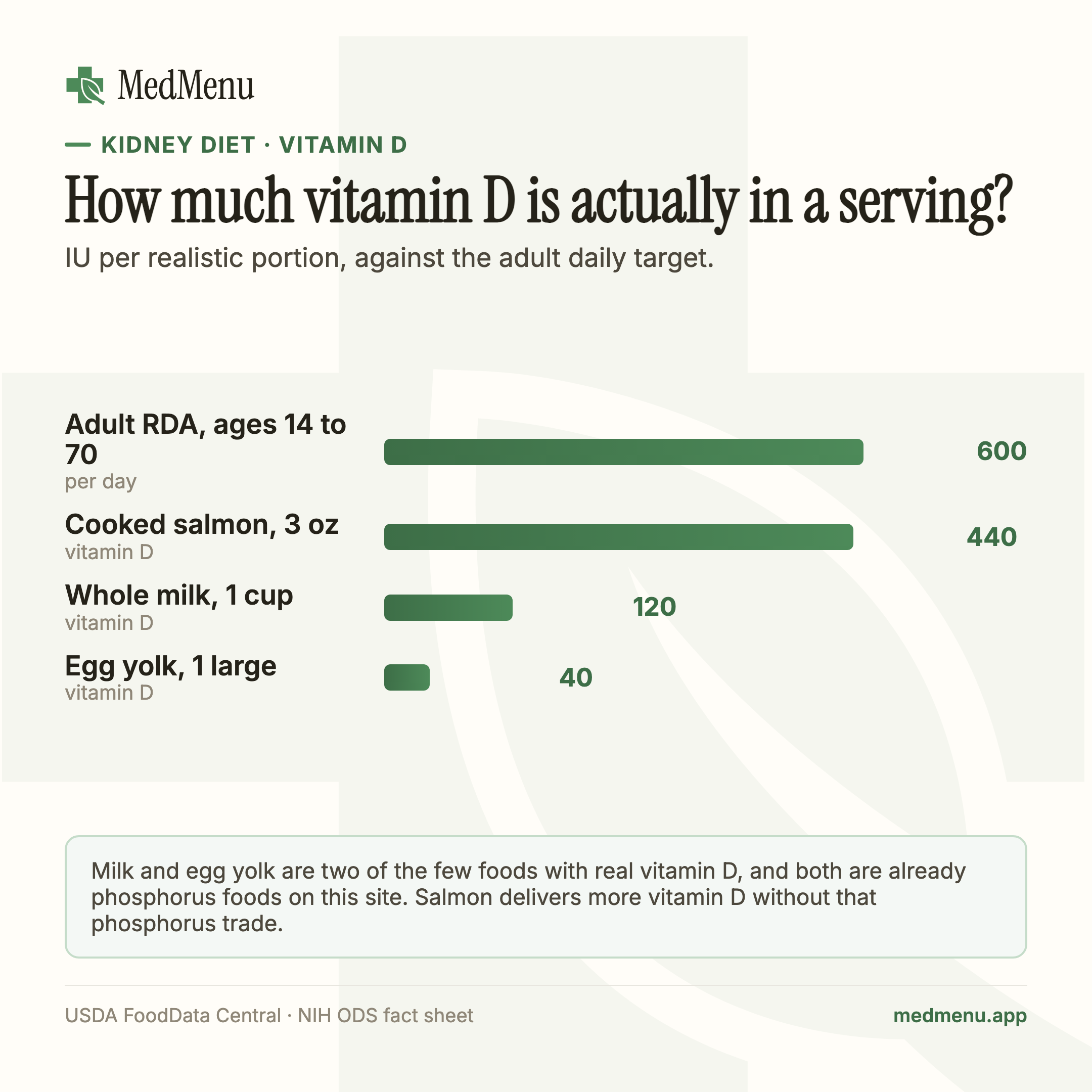
Very few foods carry meaningful vitamin D on their own, which is why sunlight normally carries most of the load. Here is what a realistic portion of the foods that do carry it actually delivers:
| Portion | Vitamin D | Phosphorus | Potassium |
|---|---|---|---|
| Salmon, cooked, 3 oz (85 g) | 11 mcg | 214 mg | 326 mg |
| Whole milk, 1 cup (244 g) | 3 mcg | 205 mg | 322 mg |
| Egg yolk, 1 large (17 g) | 1 mcg | 66 mg | 19 mg |
Vitamin D here is in micrograms (mcg), the unit USDA reports; 1 mcg equals 40 IU, so salmon's 11 mcg works out to about 440 IU. The adult RDA is 15 mcg (600 IU) a day, 20 mcg (800 IU) past age 70, so one salmon serving covers most of it in a single meal. Milk and egg yolk are both foods this site already discusses for phosphorus; the next section works out what that costs per unit of vitamin D.
All three foods above carry a real phosphorus load, so the useful comparison is not which food has the most vitamin D, it's how much phosphorus each one costs per unit of vitamin D delivered. Dividing the table above out: salmon supplies about 2.1 IU of vitamin D for every milligram of phosphorus. Whole milk supplies about 0.6, and egg yolk about 0.6, essentially tied with each other. Salmon delivers roughly three and a half times more vitamin D per phosphorus milligram than either dairy or egg yolk.
Milk and egg yolk both fit a kidney diet in ordinary portions, the same as this site's phosphorus coverage of dairy and eggs already shows; a common target if you limit phosphorus runs around 1,000 mg a day, set from your labs and stage, and one serving of either food uses only a fifth of that. If vitamin D specifically is the goal, fish is simply the more efficient route to it.
This is where the trade-off shows up. The largest meta-analysis to date on the question, 128 studies and more than 11,000 adults with CKD stages 3 through 5, found that vitamin D therapy lowered parathyroid hormone and alkaline phosphatase, both markers of the bone disease that comes with kidney disease, but it also raised serum calcium. Across the same body of evidence, vitamin D therapy did not reduce the risk of death, and its effect on fractures and cardiovascular outcomes stayed uncertain (Yeung and colleagues, 2023).
That is the reason the two forms of vitamin D are not treated the same way. Everyday over-the-counter vitamin D (D2 or D3) still needs the kidney's activation step, so its effect can be blunted exactly when it's needed most. Prescription active-form vitamin D (calcitriol and related analogs) skips that step, which is precisely why it is prescription-only and monitored: it brings the calcium-raising effect above without needing working kidneys to get there.
Too much vitamin D is its own documented risk: the federal fact sheet on vitamin D states that toxicity causes marked hypercalcemia, and in extreme cases, kidney stones, soft-tissue calcification, and renal failure. The adult upper limit is set at 4,000 IU a day for exactly this reason.
Vitamin D, potassium, and phosphorus figures for salmon, whole milk, and egg yolk come from USDA FoodData Central (Standard Reference legacy), the same spine used across this site's kidney articles. Requirement, upper-limit, and toxicity figures come from the NIH Office of Dietary Supplements fact sheet, fetched live. Deficiency prevalence and the activation mechanism come from a 2018 peer-reviewed review; the supplementation trade-off comes from a 2023 meta-analysis, the largest published on the question. This page names no specific supplement, dose, or brand to take: your nephrologist and pharmacist are the right people to review your labs and your actual bottle against your kidney function.
Sources
MedMenu is an information tool, not medical advice, and does not diagnose, treat, or manage any condition. Your nephrologist, pharmacist, and renal dietitian set your personal targets and review your specific medications and supplements against your labs and stage. Published August 17, 2026 · Last updated August 17, 2026.
This is a comprehensive website! Recipes look great and represent a variety of cuisines. You have emphasized the appropriate nutrients. Guidance tips are helpful. Science tab provides evidence-based references and are appropriate for the diseases addressed. Links to Drugs.com, WebMD & Medline are nice. As a registered dietitian, I feel comfortable recommending MedMenu.
Susan G. Rodder, MS, RDN, LD
Registered Dietitian
MedMenu offers all the data you need to plan meals based on specific dietary needs. There are lot of great recipes from a variety of cuisines to choose from, or you can test your own recipe to see how well it fits into your dietary guidelines.
Valerie B.
MedMenu user
Diabetically Speaking with SmartMove360
The kidney does more than filter vitamin D, it activates it. A second hydroxylation step that converts storage vitamin D (25-hydroxyvitamin D) into the active hormone (1,25-dihydroxyvitamin D, also called calcitriol) happens in the kidney. As kidney function declines, that conversion step weakens, which is one reason vitamin D deficiency has been reported in as many as 80% of people with chronic kidney disease, even when diet and sun exposure haven't changed.
That is a decision for your nephrologist, built from your labs, not a default yes. The largest meta-analysis to date, covering 128 studies and more than 11,000 adults with CKD, found that vitamin D therapy lowers parathyroid hormone and alkaline phosphatase, common markers of kidney-related bone disease, but also raises serum calcium, and did not reduce the risk of death. That is a real trade-off, not a simple benefit, which is why active-form prescription vitamin D is monitored with blood work rather than taken freely.
Yes. Vitamin D toxicity causes marked hypercalcemia, and the federal fact sheet on vitamin D states that in extreme cases, toxicity can cause kidney stones, calcification of soft tissue, and even renal failure. This is specifically why the adult upper intake level is set at 4,000 IU a day and why prescription active-form vitamin D is dosed and monitored by a care team rather than self-administered.
Rather not count?
A printable week built food-first, with the potassium, phosphorus and sodium worked out for every meal, so the portions are handled for you.
See the meal plan →