Foods to avoid with kidney disease / Vitamins
The honest answer inverts the question. No vitamin has guideline backing as a kidney booster, and the professional nutrition guideline for kidney disease treats every supplement as an individualized decision made from blood work. What kidney disease genuinely changes is clearance: some vitamins keep washing through as before, while others, vitamin A most clearly, build up as function falls. So the useful map is which vitamins the body stores when kidneys slow down, which ones can harm at supplement doses, and which questions to bring to your care team.
By the MedMenu Editorial Team · Published August 11, 2026
Vitamins split into two families by how the body handles a surplus. The water-soluble ones, the B vitamins and vitamin C, wash out in urine, so extra mostly leaves. The fat-soluble ones, A, D, E and K, get stored, and the kidneys participate in keeping some of them in range. Reduced kidney function shifts that balance toward accumulation.
Vitamin A is the documented example. In a study of children with chronic kidney disease, serum retinol climbed about 13% for every 10-point fall in eGFR, hypervitaminosis A was common across stages, and the elevated retinol contributed to high calcium levels (Manickavasagar and colleagues, 2015). The practical reading for anyone with reduced kidney function: a normal diet already supplies vitamin A, and stacking a supplement on top of slowed clearance is exactly the move to run past a care team first.
Vitamin D lives in the same fat-soluble family and behaves differently again, because the kidney itself activates it; that story has enough moving parts to deserve its own article rather than a paragraph here.
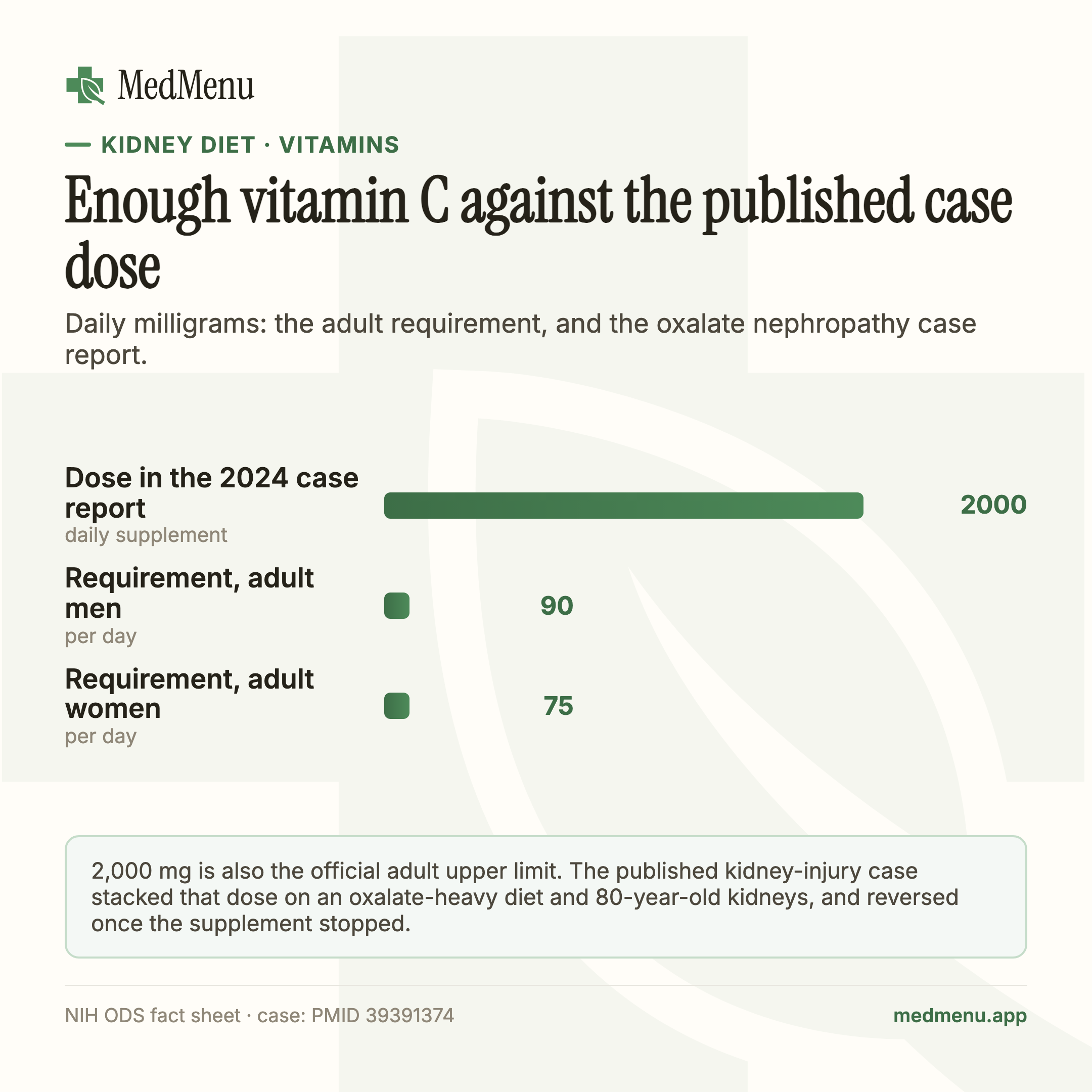
At supplement doses, yes, and vitamin C is the clearest published example. The body converts excess vitamin C into oxalate, the same substance most kidney stones are built from. An adult needs about 90 mg a day (75 mg for women), and the official upper limit is 2,000 mg. In a 2024 case report, an 80-year-old man taking 2,000 mg daily, alongside an oxalate-heavy diet, developed acute kidney injury; the biopsy showed calcium oxalate crystals lodged in the kidney tubules, and his kidney function returned close to baseline two months after the supplement stopped and the diet changed (Pal and colleagues, 2024).
The shape of that case repeats a pattern this site keeps meeting: harm arrived through a combination, a megadose habit, an oxalate-rich diet, and older kidneys, and reversed when one factor was removed. Food-level vitamin C sits nowhere near this arithmetic.
Some people with kidney disease do run low on specific vitamins, particularly around dialysis, and prescription renal vitamin formulations exist for exactly that situation; which ones, and whether you need any, is your nephrology team's call from your blood work.
The unglamorous levers carry the evidence: blood pressure control, blood sugar control, and food chosen so the minerals fit your labs. Every food article on this site is that last lever in practice, potassium, phosphorus and sodium worked out per real portion, from the low-potassium foods list to the portion-by-portion overview.
Whole foods also deliver vitamins inside the package the guideline's food-first baseline assumes, which is the quiet reason "eat the fruit, skip the megadose" keeps being the answer clinicians reach for.
Diabetes raises the stakes on the same map rather than adding a new one:
The combined food targets live in our diabetic kidney disease diet guide, and the other supplement question this site covers, creatine and the lab number it moves, is worked through in is creatine bad for your kidneys.
Study findings come from the cited publications, each verified live on PubMed before citation, with effect sizes and case details quoted as published; the vitamin A findings come from a study in children with chronic kidney disease and are attributed as such. Daily requirement and upper-limit figures come from the NIH Office of Dietary Supplements fact sheet. This page names no supplement to take: the guideline it rests on treats supplementation as an individualized clinical decision, and your care team makes it from your labs.
Sources
MedMenu is an information tool, not medical advice, and does not diagnose, treat, or manage any condition. Your nephrologist and renal dietitian set your personal targets from your labs and stage. Published August 11, 2026 · Last updated August 11, 2026.
This is a comprehensive website! Recipes look great and represent a variety of cuisines. You have emphasized the appropriate nutrients. Guidance tips are helpful. Science tab provides evidence-based references and are appropriate for the diseases addressed. Links to Drugs.com, WebMD & Medline are nice. As a registered dietitian, I feel comfortable recommending MedMenu.
Susan G. Rodder, MS, RDN, LD
Registered Dietitian
MedMenu offers all the data you need to plan meals based on specific dietary needs. There are lot of great recipes from a variety of cuisines to choose from, or you can test your own recipe to see how well it fits into your dietary guidelines.
Valerie B.
MedMenu user
Diabetically Speaking with SmartMove360
No vitamin has guideline backing as a kidney booster. The 2020 update of the main professional nutrition guideline for kidney disease treats vitamin supplementation as an individualized clinical decision made from blood work and dietary intake rather than a standing recommendation. For kidney health the evidence points at the ordinary things: blood pressure, blood sugar, and food-first nutrition, with vitamins coming from the diet unless your care team finds a specific gap.
The fat-soluble ones are the main concern, and vitamin A is the documented example. Kidneys help clear retinol, so levels climb as function falls; in a study of children with chronic kidney disease, retinol rose about 13% for every 10-point drop in eGFR, hypervitaminosis A was common, and it contributed to elevated calcium. This is why routinely adding vitamin A on top of a normal diet is the kind of decision that belongs to a care team looking at labs.
Food amounts are a non-issue; sustained high-dose supplements are a different object. The body turns excess vitamin C into oxalate, which is what kidney stones and oxalate crystal deposits are made of. In a 2024 published case, an 80-year-old man taking 2,000 mg a day, the official adult upper limit and more than 20 times the 90 mg daily requirement, alongside an oxalate-heavy diet, developed acute kidney injury with biopsy-confirmed oxalate nephropathy, and recovered to near baseline after stopping the supplement. If you take high-dose vitamin C and have any kidney concern, that is a conversation for your next appointment.
Rather not count?
A printable week built food-first, with the potassium, phosphorus and sodium worked out for every meal, so the portions are handled for you.
See the meal plan →