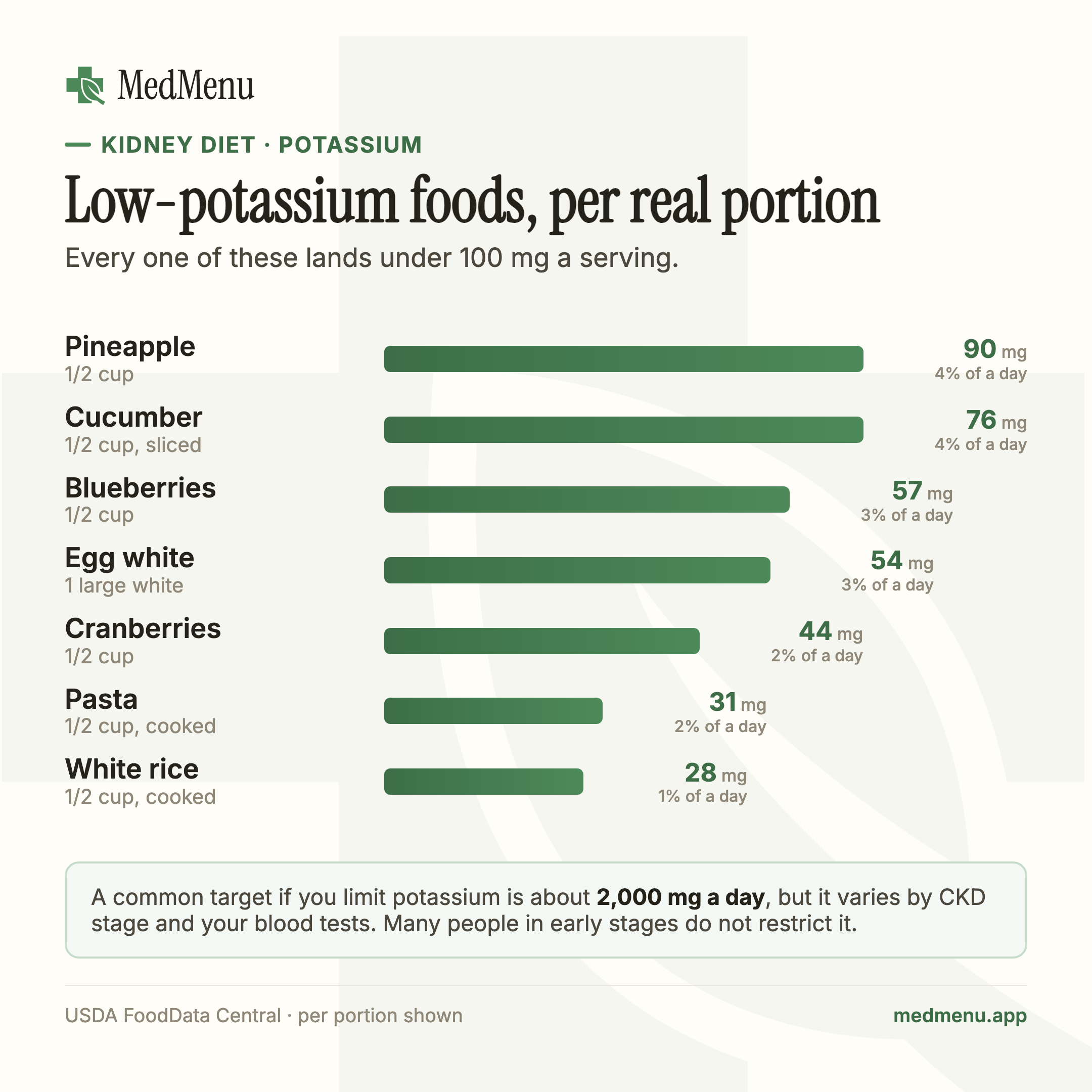
Kidney diet · Potassium
Below are the everyday foods that come in low in potassium, grouped by type, with the exact milligrams per portion from the USDA database. Where it helps, we note which ones also suit blood sugar, because managing kidneys and diabetes together changes some of the picks.
By the MedMenu Editorial Team · Published July 20, 2026
Per typical serving, starting with the fresh options, since these are low in potassium and worth eating on every other count too:
Renal dietitians commonly treat under about 200 mg of potassium per serving as low, 200 to 300 mg as medium, and above that as high. It is a working guide, not a fixed rule. Many kidney diets aim for around 2,000 mg of potassium a day, but there is no single limit that fits everyone: how much you need depends on your blood test results, which your care team tracks. The foods below make it easy to stay under whatever number is yours.
| Fruit | Portion | Potassium |
|---|---|---|
| Cranberries | 1/2 cup | 44 mg |
| Blueberries | 1/2 cup | 57 mg |
| Pineapple | 1/2 cup | 90 mg |
| Strawberries | 1/2 cup | 127 mg |
| Grapes | 1/2 cup | 145 mg |
| Watermelon | 1 cup, diced | 170 mg |
| Apple | 1 medium | 195 mg |
For snacks, read the box rather than the front of it: some reduced-sodium snacks swap salt for potassium. Notice that the two whole fruits sit at the bottom, because a medium apple weighs more than twice what half a cup of berries does. The cup shown for watermelon also undersells a real serving: a single wedge runs closer to double it. The full low potassium fruit list ranks 20 fruits this way and shows what drying changes.
| Vegetable | Portion | Potassium |
|---|---|---|
| Onion | 1/4 cup, raw | 58 mg |
| Cucumber | 1/2 cup, sliced | 76 mg |
| Cauliflower | 1/2 cup, cooked | 88 mg |
| Green beans | 1/2 cup, cooked | 99 mg |
| Cabbage | 1/2 cup, cooked | 147 mg |
| Red bell pepper | 1/2 cup, raw | 158 mg |
With vegetables the cooking method matters as much as the choice: boiling and draining takes kale from 348 mg per 100 g down to 144. The low potassium vegetables guide ranks 28 of them and shows what boiling and roasting each change.
| White rice, 1/2 cup | 28 mg |
| Pasta, 1/2 cup | 31 mg |
| White bread, 1 slice | 32 mg |
| Egg white, 1 large | 54 mg |
| Egg, 1 large | 63 mg |
| Chicken breast, 3 oz | 218 mg |
Chicken and other meats are low-to-moderate in potassium but carry phosphorus, so portion protein to your stage. Egg white is the lowest in both.
The simplest approach: start with a low-potassium base (rice, pasta or bread), add a low-potassium protein (egg or a portion of chicken), and fill out with low-potassium vegetables (cucumber, green beans, cabbage, bell pepper). If you want a higher-potassium food like a potato, cutting it small and boiling it in plenty of water lowers the potassium, covered in our guide to potatoes and kidney disease. For more ways to bring your levels down, see what foods lower potassium, or low-potassium breakfast foods for the trickiest meal of the day.
Here the low-potassium list needs a second look, because diabetes is the most common cause of kidney disease and some low-potassium staples are high on the glycemic index. That splits the list into two:
Low potassium and low glycemic (double wins)
Strawberries, blueberries, cauliflower, green beans, cucumber, bell pepper, egg, egg white, chicken.
Low potassium but watch the blood sugar
White rice, white bread, watermelon, grapes, pineapple. Kidney-friendly, but portion them and pair with protein.
The point is to portion the second group, not avoid it. A low-potassium plate and a blood-sugar-steady plate can be the same plate when you choose with both numbers in view.
Every potassium figure comes from USDA FoodData Central (Standard Reference legacy), for the portion shown. The low, medium and high bands are the working thresholds renal dietitians commonly use; how much potassium you need to limit is set from your blood test results.
Sources
MedMenu is an information tool, not medical advice, and does not diagnose, treat, or manage any condition. Your nephrologist and renal dietitian set your personal targets from your labs and stage. Published July 20, 2026 · Last updated July 20, 2026.
This is a comprehensive website! Recipes look great and represent a variety of cuisines. You have emphasized the appropriate nutrients. Guidance tips are helpful. Science tab provides evidence-based references and are appropriate for the diseases addressed. Links to Drugs.com, WebMD & Medline are nice. As a registered dietitian, I feel comfortable recommending MedMenu.
Susan G. Rodder, MS, RDN, LD
Registered Dietitian
MedMenu offers all the data you need to plan meals based on specific dietary needs. There are lot of great recipes from a variety of cuisines to choose from, or you can test your own recipe to see how well it fits into your dietary guidelines.
Valerie B.
MedMenu user
Diabetically Speaking with SmartMove360
Among the lowest per serving: pasta and white rice (about 30 mg per half cup), white bread (32 mg a slice), cranberries (44 mg per half cup), egg white (54 mg), blueberries (57 mg) and cucumber (76 mg per half cup).
Build meals from low-potassium staples: a grain like pasta, rice or bread, a low-potassium protein like egg or chicken, and low-potassium vegetables like cucumber, green beans, cabbage or bell pepper. Note that food does not remove potassium already in your blood; for that, follow your care team's guidance.
No. A medium banana is about 422 mg, which is high for a single food. Lower-potassium fruit swaps include berries, cranberries and apple. See can you eat bananas with kidney disease.
Rather not count?
A printable week built from low-potassium foods, with the potassium, phosphorus and sodium worked out for every meal.
See the meal plan →