Kidney diet · Statistics · Produce
Half a cup of apple juice runs about 125 mg of potassium, the lowest fresh-produce figure audited here. A whole avocado runs about 975 mg, the highest. In between sit fresh, cooked, canned, dried and juiced forms of the same everyday fruits and vegetables, each with its own number below, sourced to USDA FoodData Central.
By the MedMenu Editorial Team · Published August 15, 2026
Cite this data
Every figure below traces to USDA FoodData Central. If you reference a number from this table, use the box below to credit it.
MedMenu. "Potassium in Fruits & Vegetables, Ranked by Portion." 2026. https://medmenu.app/eat-well/potassium-in-fruits-vegetables. Data: USDA FoodData Central, Standard Reference Legacy.
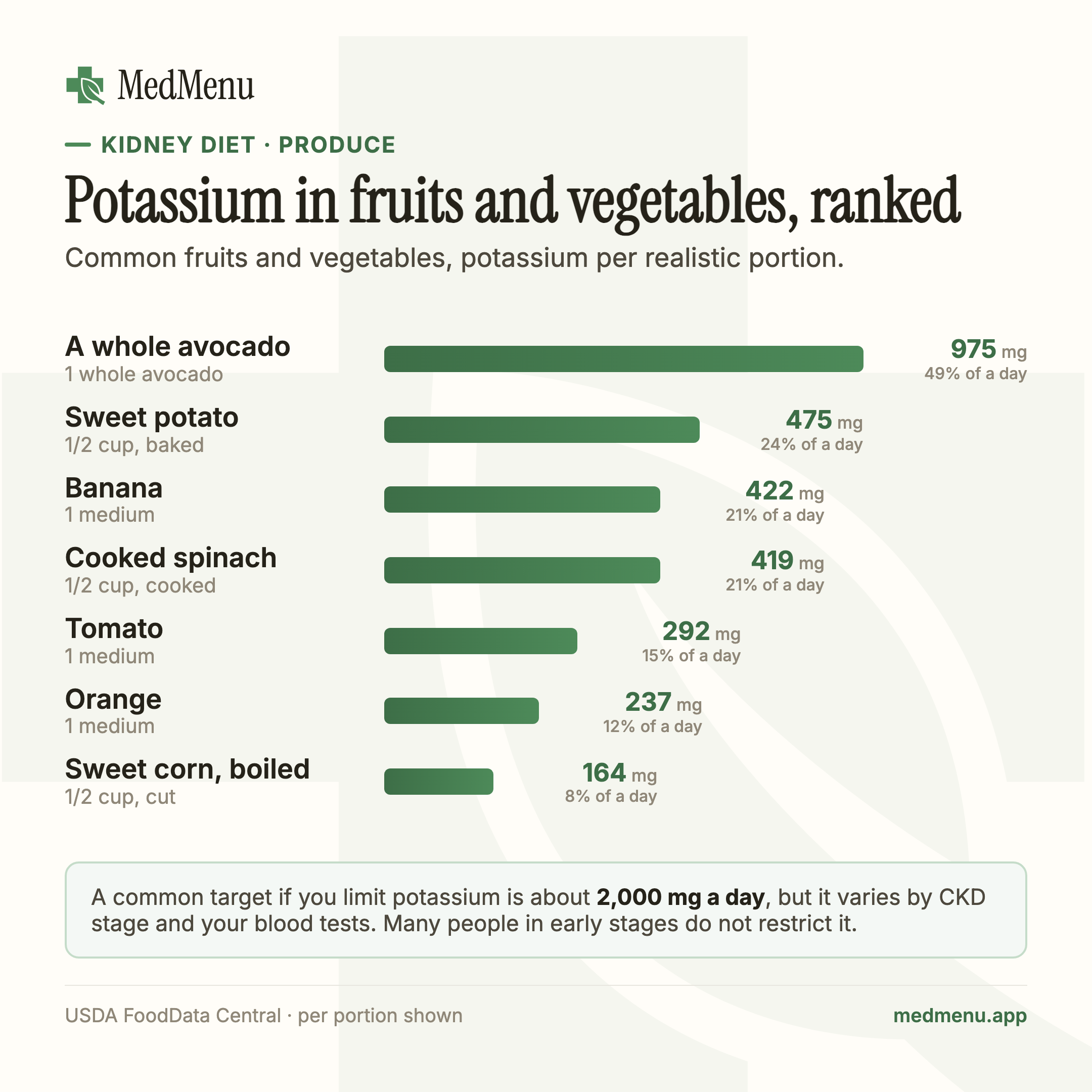
Milligrams of potassium in a realistic serving:
For scale, many kidney diets work around 2,000 mg of potassium a day as a common reference point, set from your CKD stage and blood tests. Many people in early stages are not asked to restrict it at all.
Ranked low to high, with phosphorus and carbohydrate shown for the same portion.
| Food | Portion | Potassium mg | Phosphorus mg | Sodium mg | Carb g |
|---|---|---|---|---|---|
| Apple juice | 1/2 cup (124 g) | 125 | 9 | 5 | 14 |
| Sweet corn, boiled | 1/2 cup, cut (75 g) | 164 | 58 | 1 | 16 |
| Raw spinach | 1 cup, raw (30 g) | 167 | 15 | 24 | 1 |
| Orange | 1 medium (131 g) | 237 | 18 | 0 | 15 |
| Avocado | 1/4 avocado (50 g) | 242 | 26 | 4 | 4 |
| Brussels sprouts, boiled | 1/2 cup (78 g) | 247 | 44 | 16 | 6 |
| Beets, boiled | 1/2 cup, sliced (85 g) | 259 | 32 | 65 | 8 |
| Raisins | 1/4 cup (36 g) | 268 | 35 | 9 | 29 |
| Tomato | 1 medium (123 g) | 292 | 30 | 6 | 5 |
| Baked potato | 1/2 medium, flesh (78 g) | 305 | 39 | 4 | 17 |
| Prunes (dried plums) | 5 prunes (42 g) | 307 | 29 | 1 | 27 |
| Tomato paste, canned | 2 tbsp (32 g) | 324 | 27 | 19 | 6 |
| Tomato sauce, canned | 1/2 cup (122 g) | 362 | 33 | 578 | 6 |
| Dried apricots | 1/4 cup (33 g) | 383 | 23 | 3 | 21 |
| Packaged coconut water | 1 cup (240 g) | 396 | 12 | 62 | 10 |
| Cooked spinach | 1/2 cup, cooked (90 g) | 419 | 50 | 63 | 3 |
| Banana | 1 medium (118 g) | 422 | 26 | 1 | 27 |
| Portabella, grilled | 100 g | 437 | 135 | 11 | 4 |
| Sweet potato | 1/2 cup, baked (100 g) | 475 | 54 | 36 | 21 |
| Sun-dried tomatoes | 1/4 cup (14 g) | 480 | 50 | 15 | 8 |
| Half an avocado | 1/2 avocado (100 g) | 485 | 52 | 7 | 9 |
| White mushrooms, microwaved | 100 g | 488 | 127 | 17 | 6 |
| A cup of orange juice | 1 cup (248 g) | 496 | 42 | 2 | 26 |
| Tomato juice, canned | 1 cup (243 g) | 527 | 46 | 615 | 9 |
| Fresh coconut water | 1 cup (240 g) | 600 | 48 | 252 | 9 |
| A whole avocado | 1 whole avocado (201 g) | 975 | 105 | 14 | 17 |
26 fruits and vegetables, in fresh, cooked, canned, dried and juiced forms. Green marks the lowest-potassium rows, amber the highest potassium or sodium rows.
Yes, and the table above makes the pattern visible across fruit and vegetable together rather than one at a time. A fresh tomato is about 292 mg per medium fruit. Reduce it to sauce and the same fruit runs to 362 mg per half cup; as paste, 324 mg in two tablespoons, a much smaller portion; sun-dried, 480 mg in a quarter cup. Nothing is added in any of these steps. Water leaves, and the potassium that was already there becomes more concentrated in what is left. The full processing chain, with every intermediate step, is in the tomato guide.
Juice follows a related but distinct pattern: it is not concentration so much as volume without the fiber that would normally slow you down. A cup of orange juice, about 496 mg, holds more potassium than a whole orange, about 237 mg, because a glass packs several oranges' worth of juice into one serving. Tomato juice follows the same pattern against its own whole fruit. Coconut water starts higher still: 396 mg per cup packaged, 600 mg fresh.
Carbohydrate and potassium do not always move together in this table, which matters if you are counting both. Raisins and prunes are moderate on potassium but carry 27 to 29 g of carbohydrate in a small quarter-cup or five-prune serving, more than a whole banana in less volume. Orange juice and apple juice run similarly high on carbohydrate relative to their size. On the other end, a whole avocado is the highest-potassium food in this table at 975 mg, yet carries only 17 g of carbohydrate, making portion size the main lever for potassium rather than the carbohydrate count.
Every value is from USDA FoodData Central (Standard Reference legacy), for the exact preparation named in each row, since raw, boiled, canned, dried and juiced forms of the same food are separate USDA entries with separate numbers. Serving sizes are USDA's own household measure weights for that preparation. Nothing on this page is hand-typed or estimated; every row is pulled directly from the same audited data file behind MedMenu's other kidney content.
Sources
Not medical advice. MedMenu helps you find food choices that align with published dietary guidelines; every figure above shows its source, and none of it replaces your care team. There is no single potassium limit that fits everyone; your nephrologist or renal dietitian sets yours from your CKD stage and blood test results. Published August 15, 2026 · Last updated August 15, 2026.
This is a comprehensive website! Recipes look great and represent a variety of cuisines. You have emphasized the appropriate nutrients. Guidance tips are helpful. Science tab provides evidence-based references and are appropriate for the diseases addressed. Links to Drugs.com, WebMD & Medline are nice. As a registered dietitian, I feel comfortable recommending MedMenu.
Susan G. Rodder, MS, RDN, LD
Registered Dietitian
MedMenu offers all the data you need to plan meals based on specific dietary needs. There are lot of great recipes from a variety of cuisines to choose from, or you can test your own recipe to see how well it fits into your dietary guidelines.
Valerie B.
MedMenu user
Diabetically Speaking with SmartMove360
Among the foods in this table, half a cup of apple juice is lowest at about 125 mg, followed by half a cup of boiled sweet corn at 164 mg and a cup of raw spinach at 167 mg.
A whole avocado, at about 975 mg, the highest in this table by a wide margin. A cup of fresh coconut water follows at about 600 mg.
It concentrates it rather than removing it. A fresh tomato is about 292 mg per medium fruit, but the same tomato reduced to sauce, paste or sun-dried form carries more potassium per realistic serving, because water leaves and the minerals stay behind.
Usually higher for the same size serving, because a glass of juice packs the potassium from several pieces of fruit into one cup with none of the fiber that would slow you down eating them whole. A cup of orange juice is about 496 mg against 237 mg for one whole orange.
Rather not count?
A printable week where the fruits and vegetables and their potassium are already counted for every meal.
See the meal plan →