Kidney diet · Vegetables
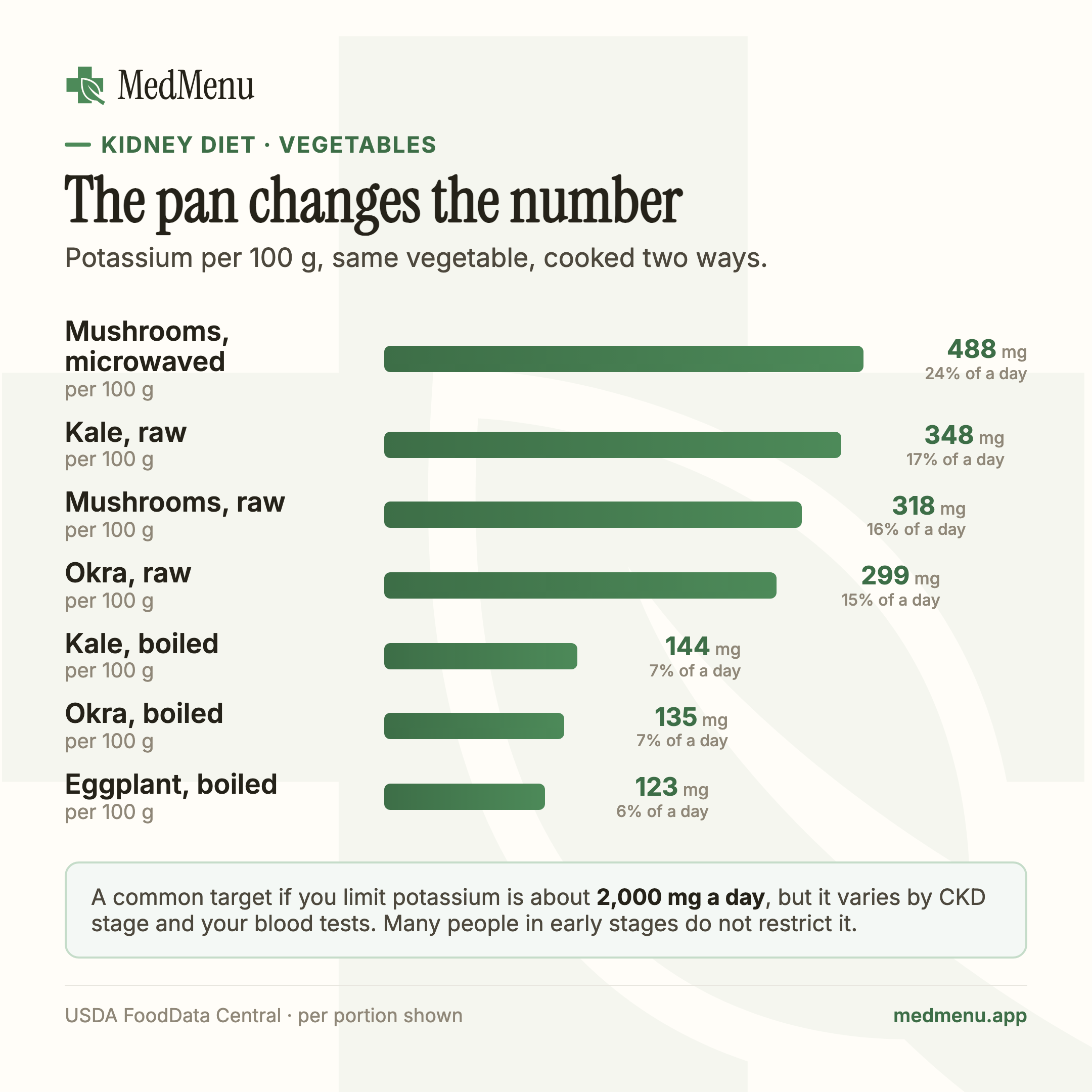
Cucumber, cabbage, cauliflower, green beans, onion, peppers and lettuce are the everyday low-potassium vegetables. For vegetables, how you cook them can move the potassium more than which one you pick, a detail most lists skip. Boiling kale in plenty of water takes it from 348 mg per 100 g down to 144, while grilling a portabella pushes it from 364 up to 437, same vegetable, different pan.
By the MedMenu Editorial Team · Published July 21, 2026
Milligrams of potassium in a normal serving of each:
For scale, a common working reference is about 2,000 mg of potassium a day, though it varies by kidney stage and blood test results, and many people in early stages are not asked to limit potassium at all. Half a cup of cauliflower is roughly 4% of that.
For some of them, a lot of it. Potassium dissolves in water, so when you boil a vegetable in plenty of water and pour that water away, some of the potassium goes down the drain with it. The effect is big enough to change which band a vegetable sits in:
| Vegetable | Raw per 100 g | Boiled per 100 g | Change |
|---|---|---|---|
| Kale | 348 | 144 | -59% |
| Okra | 299 | 135 | -55% |
| Eggplant | 229 | 123 | -46% |
| Carrots | 320 | 235 | -27% |
| Asparagus | 202 | 224 | +11% |
| Green peas | 244 | 271 | +11% |
| Zucchini | 261 | 264 | +1% |
Notice the last three rows. Boiling is a tool for some vegetables, not a rule for all of them, and anyone who tells you to boil everything is overselling it. Asparagus and peas read the same or slightly higher after boiling, partly because they take on water and lose other solids. If you want the method that works hardest, cut the vegetable small, use a big pot of water, and drain it; that is the same technique covered in detail in our guide to potatoes and kidney disease.
Yes. Dry heat drives water off instead of pulling minerals out, so what is left is more concentrated, a detail cooking advice often skips. Nothing is added to the food; the water simply leaves and the potassium stays behind.
Per 100 g, so the comparison is like for like.
Keep roasting vegetables; just weigh the tray against the pot when a vegetable is already high, and remember that a roasted portion shrinks, so the same forkful carries more than it did raw. The same mechanism taken further is what turns a modest fresh tomato into concentrated paste and sun-dried tomatoes; the tomato guide walks that ladder with the numbers.
Ranked by a realistic serving, lowest first, with carbohydrate alongside because vegetables are where a kidney diet and a diabetes diet agree most easily.
| Vegetable | Serving | Potassium mg | Carbs g |
|---|---|---|---|
| Onion | 1/4 cup, raw | 58 | 4 |
| Eggplant, boiled | 1/2 cup, cubes | 62 | 4 |
| Kale, raw | 1 cup | 73 | 1 |
| Cucumber | 1/2 cup, sliced | 76 | 2 |
| Green bell pepper | 1/2 cup, sliced | 80 | 2 |
| Kale, boiled | 1/2 cup | 85 | 3 |
| Cauliflower | 1/2 cup, cooked | 88 | 3 |
| Green beans | 1/2 cup, cooked | 99 | 5 |
| Iceberg lettuce | 1 cup, shredded | 102 | 2 |
| Okra, boiled | 1/2 cup, sliced | 108 | 4 |
| White mushrooms, raw | 1/2 cup, pieces | 111 | 1 |
| Celery | 1/2 cup, chopped | 133 | 2 |
| Radishes | 1/2 cup, sliced | 135 | 2 |
| Cabbage | 1/2 cup, cooked | 147 | 4 |
| Red bell pepper | 1/2 cup, raw | 158 | 5 |
| Sweet corn, boiled | 1/2 cup, cut | 164 | 16 |
| Carrots, boiled | 1/2 cup, sliced | 183 | 6 |
| Asparagus, boiled | 1/2 cup | 202 | 4 |
| Carrots, raw | 1/2 cup, chopped | 205 | 6 |
| Green peas, boiled | 1/2 cup | 217 | 13 |
| Broccoli, boiled | 1/2 cup, chopped | 229 | 6 |
| Zucchini, boiled | 1/2 cup, sliced | 238 | 2 |
| Brussels sprouts, boiled | 1/2 cup | 247 | 6 |
| Beets, boiled | 1/2 cup, sliced | 259 | 8 |
| Tomato | 1 medium | 292 | 5 |
| Baked potato | 1/2 medium, flesh | 305 | 17 |
| Cooked spinach | 1/2 cup, cooked | 419 | 3 |
| Sweet potato | 1/2 cup, baked | 475 | 21 |
Green marks a serving under 150 mg, amber one over 300 mg. The amber rows stay on the menu; portion and count them, and the full low potassium foods list puts them next to the other food groups.
Vegetables are the easiest place to serve both conditions at once, because nearly everything in the green band above is also low in carbohydrate. Cucumber, cauliflower, green beans, peppers, lettuce, radishes, celery and boiled eggplant all clear both bars without you having to trade one number against the other, at 5 g of carbohydrate a serving or under.
The exceptions are the starchy ones, and they stack up on both counts: half a cup of boiled corn is 164 mg of potassium with 16 g of carbohydrate, green peas 217 mg with 13 g, and beets 259 mg with 8 g of mostly sugar. Half a baked potato is 305 mg and 17 g. These are the vegetables where a small portion does double duty.
One quiet win: boiling helps the kidney number without touching the carbohydrate, so boiled-then-drained vegetables are one of the few moves that improves one condition without costing you anything on the other. Where the two diets genuinely collide is starches and beans, worked through in the diabetic kidney disease diet guide.
Every value comes from USDA FoodData Central (Standard Reference legacy), for the exact preparation named in each row, since raw, boiled and grilled are separate entries with separate numbers. Serving weights are USDA's own measure weights for that preparation; where USDA lists only a full cup, the half-cup figure is that weight halved. Cooking comparisons are shown per 100 g so they are like for like. The daily figure used for scale is the roughly 2,000 mg a day many renal diets work from; it is a reference, not a personal limit, and your care team sets yours from your stage and blood tests.
Sources
MedMenu is an information tool, not medical advice, and does not diagnose, treat, or manage any condition. Your nephrologist and renal dietitian set your personal targets from your labs and stage. Published July 21, 2026 · Last updated July 21, 2026.
This is a comprehensive website! Recipes look great and represent a variety of cuisines. You have emphasized the appropriate nutrients. Guidance tips are helpful. Science tab provides evidence-based references and are appropriate for the diseases addressed. Links to Drugs.com, WebMD & Medline are nice. As a registered dietitian, I feel comfortable recommending MedMenu.
Susan G. Rodder, MS, RDN, LD
Registered Dietitian
MedMenu offers all the data you need to plan meals based on specific dietary needs. There are lot of great recipes from a variety of cuisines to choose from, or you can test your own recipe to see how well it fits into your dietary guidelines.
Valerie B.
MedMenu user
Diabetically Speaking with SmartMove360
Per serving: onion at about 58 mg a quarter cup, boiled eggplant at 62 mg a half cup, raw kale at 73 mg a cup, cucumber at 76 mg, green bell pepper at 80 mg, boiled kale at 85 mg and cauliflower at 88 mg. Green beans, iceberg lettuce, boiled okra and raw mushrooms all land near 100 mg.
For some, a lot. Potassium dissolves into the cooking water, so boiling and draining takes kale from about 348 mg per 100 g to 144 mg, okra from 299 to 135 and eggplant from 229 to 123. It is not universal: asparagus and peas read the same or higher after boiling.
Dry heat drives water off and concentrates what is left, so the same food reads higher per gram. White mushrooms go from about 318 mg per 100 g raw to 488 mg microwaved, and portabella from 364 mg raw to 437 mg grilled. Nothing is added; the water leaves and the minerals stay.
They are middling rather than low. Half a cup of raw chopped carrot is about 205 mg and boiled carrot 183 mg; half a cup of boiled broccoli is about 229 mg. Both fit in a normal day, they are just not in the same band as cucumber, cabbage or cauliflower.
Rather not count?
A printable week where the vegetables and the cooking methods are already chosen, with potassium, sodium and phosphorus counted for every meal.
See the meal plan →