Kidney diet · Snacks
The best answers here sit outside the snack aisle entirely. Half a cup of blueberries is 57 mg of potassium, sliced cucumber is 76 mg, green pepper strips 80 mg, pineapple 90 mg, and every one of them is real food rather than a package. If you do want something from a box, the numbers below cover a detail packaging rarely states: when sodium comes out of a packaged snack, potassium often goes in, and low-salt saltines carry about four to five times the potassium of the regular ones.
By the MedMenu Editorial Team · Published July 21, 2026
Fresh food first, because these are low in potassium and worth eating. Milligrams per normal serving:
For scale, a common working reference is about 2,000 mg of potassium a day, though it varies by kidney stage and blood test results, and many people in early stages are not asked to limit potassium at all. Every item on this list is under 6% of that, and none of them come out of a packet.
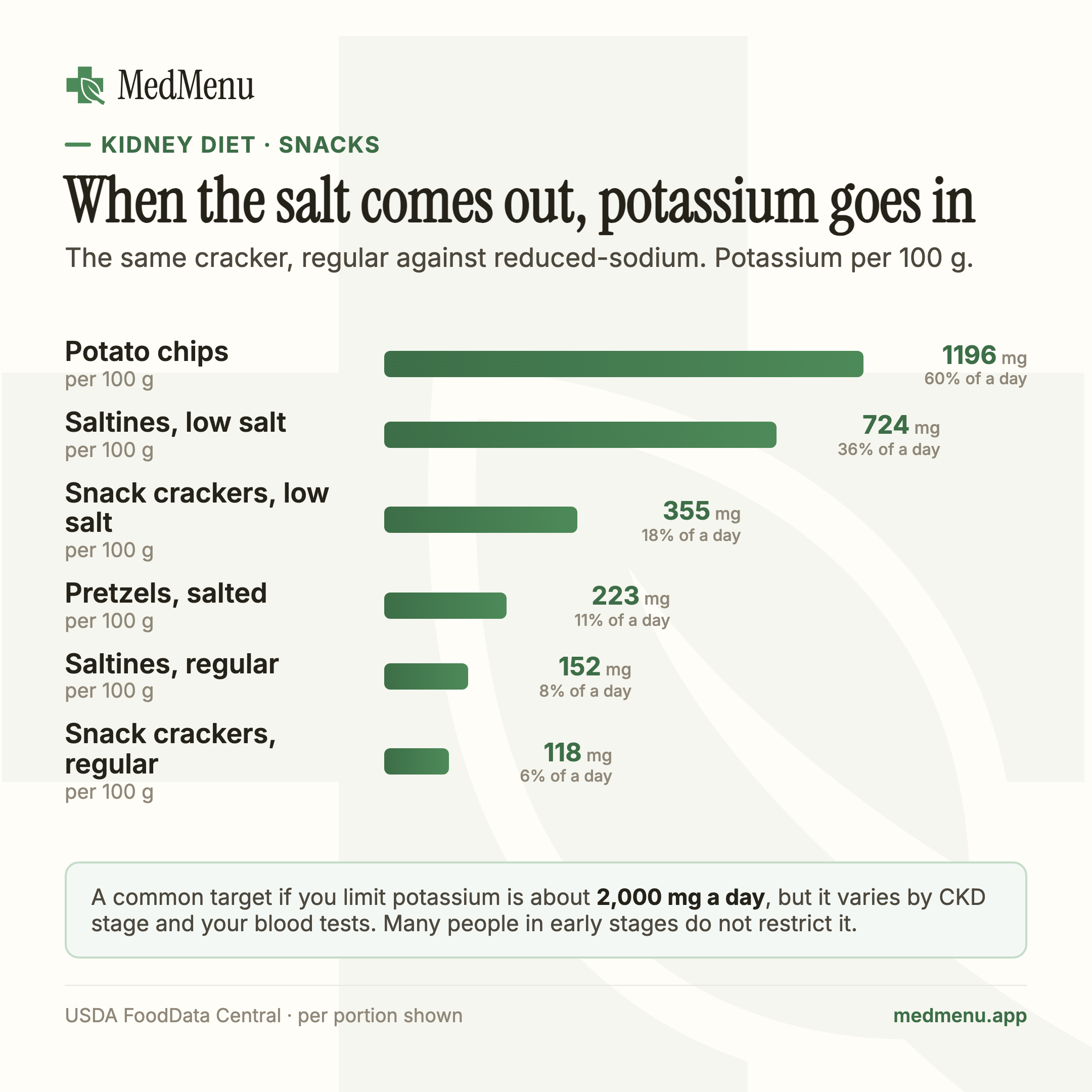
Because something has to do the job salt was doing, and that something is often potassium chloride. It is a normal, legal ingredient, and for most shoppers it is an improvement. If you are watching potassium, it quietly works against you, and the front of the box will not mention it. Compare the same cracker, per 100 g:
| Per 100 g | Potas. regular | Potas. low salt | Sodium regular | Sodium low salt |
|---|---|---|---|---|
| Saltine crackers | 152 | 724 | 941 | 198 |
| Snack crackers | 118 | 355 | 726 | 216 |
The saltines trade about 743 mg of sodium for about 572 mg of potassium per 100 g. Whether that is a good trade depends on which number your care team is watching. With high blood pressure and no potassium restriction it may be a real improvement; with potassium limits, it is the opposite.
What to do about it is simple: turn the box over and read the ingredient list. If potassium chloride is in it, treat the snack as a potassium food regardless of what the front says. The same goes for salt substitutes at the table, which are usually potassium chloride in a shaker.
Not every reduced-sodium product does this, and brands vary. The USDA entries above are averages for the category, so the label on the box in your hand is the one that counts.
Packaged snacks are part of real life, so here are the honest numbers, ranked by potassium with phosphorus and carbohydrate alongside. Read all three columns rather than the first one: a good snack needs more than a low potassium number. The two lowest rows are almost pure sugar, and they are on this table because the ranking puts them there, not because they are a recommendation.
| Snack | Serving | Potas. mg | Phos. mg | Carbs g |
|---|---|---|---|---|
| Hard candy | 1 oz | 1 | 1 | 27 |
| Jellybeans | 10 large | 10 | 1 | 26 |
| Snack crackers | 5 crackers | 19 | 40 | 10 |
| Saltine crackers | 5 crackers | 23 | 15 | 11 |
| Mozzarella string cheese | 1 stick, 1 oz | 24 | 130 | 1 |
| Animal crackers | 1 oz | 28 | 32 | 21 |
| Vanilla wafers | 8 wafers | 30 | 26 | 22 |
| Snack crackers, low salt | about 5 crackers | 50 | 32 | 9 |
| Tortilla chips | 1 oz | 51 | 63 | 19 |
| Rice cakes | 2 cakes | 52 | 65 | 15 |
| Pretzels, salted | 1 oz | 62 | 36 | 23 |
| Popcorn, air-popped | 3 cups, popped | 79 | 86 | 19 |
| Hummus | 2 tbsp | 94 | 54 | 4 |
| Saltines, low salt | about 5 crackers | 101 | 16 | 10 |
| Pretzels, whole wheat | 1 oz | 120 | 35 | 23 |
| Cottage cheese, 2% | 1/2 cup | 141 | 170 | 5 |
| Peanut butter | 2 tbsp | 179 | 107 | 7 |
| Trail mix | 1 oz | 192 | 97 | 13 |
| Potato chips, salted | 1 oz, about 22 chips | 335 | 43 | 15 |
On the whole picture, fresh fruit or a few vegetable sticks beat everything on this table, which is why the fresh list sits above this one. This table skips sodium because nearly every savoury snack is salted; if that is your main concern, start with foods low in both sodium and potassium and the seasoning and condiment numbers.
This is the second inversion, and it catches people who are doing everything right. The snacks recommended everywhere else, the ones built from nuts, seeds, beans and dairy, are the mineral-heavy end of this list. An ounce of trail mix is 192 mg of potassium and 97 mg of phosphorus. Two tablespoons of peanut butter are 179 mg and 107 mg. Half a cup of cottage cheese is 141 mg of potassium and 170 mg of phosphorus. A stick of string cheese is only 24 mg of potassium but 130 mg of phosphorus.
These are portioned foods, a small handful rather than a bowl, two spoons rather than four, not items to cut out entirely. The pattern is the same one that runs through the whole kidney diet: portion the concentrated foods rather than banning them, and reach for fresh produce first, which stays low on every column at once.
Snacks are the hardest meal to serve both conditions. The savoury options just below them, snack crackers at 19 mg, saltines at 23 mg and string cheese at 24 mg, are lower still in potassium and carry far less sugar, which is where the two goals actually meet. Look at the top of the table: the two lowest-potassium snacks on the list are hard candy at 1 mg and jellybeans at 10 mg, and they are there because they are close to pure sugar, at 27 g and 26 g of carbohydrate a serving. They solve the mineral problem by failing the glucose one. Chocolate sits between the two extremes, and which bar you pick moves both numbers; the trade is worked through in is chocolate bad for kidney disease.
Three that do hold up on both: hummus, 94 mg of potassium for 4 g of carbohydrate and a very low glycemic index; string cheese, 24 mg of potassium and 1 g of carbohydrate, watching the 130 mg of phosphorus; and air-popped popcorn, 79 mg of potassium for a genuine three-cup bowl, though at 19 g of carbohydrate it counts as a carb serving.
The full picture of where these two diets pull apart, and what to do about it, is in the diabetic kidney disease diet guide.
Values come from USDA FoodData Central (Standard Reference legacy) for the servings shown, using USDA's own measure weights, and the regular and reduced-sodium entries are separate USDA foods rather than estimates. Category averages are not brand labels, so where a product matters to you, the ingredient list and nutrition panel on that box are the final word. The daily figure used for scale is the roughly 2,000 mg of potassium a day many renal diets work from; it varies by kidney stage and blood tests, and many people in early stages are not asked to limit potassium at all.
Sources
MedMenu is an information tool, not medical advice, and does not diagnose, treat, or manage any condition. Your nephrologist and renal dietitian set your personal targets from your labs and stage. Published July 21, 2026 · Last updated July 21, 2026.
This is a comprehensive website! Recipes look great and represent a variety of cuisines. You have emphasized the appropriate nutrients. Guidance tips are helpful. Science tab provides evidence-based references and are appropriate for the diseases addressed. Links to Drugs.com, WebMD & Medline are nice. As a registered dietitian, I feel comfortable recommending MedMenu.
Susan G. Rodder, MS, RDN, LD
Registered Dietitian
MedMenu offers all the data you need to plan meals based on specific dietary needs. There are lot of great recipes from a variety of cuisines to choose from, or you can test your own recipe to see how well it fits into your dietary guidelines.
Valerie B.
MedMenu user
Diabetically Speaking with SmartMove360
Fresh food, mostly. Half a cup of cranberries is about 44 mg of potassium, blueberries 57 mg, a boiled egg 63 mg, sliced cucumber 76 mg, green pepper 80 mg, pineapple 90 mg and raspberries 94 mg. Among packaged options, five snack crackers are 19 mg, five saltines 23 mg, a stick of string cheese 24 mg and three cups of air-popped popcorn 79 mg. Hard candy and jellybeans are the lowest of all in potassium and are close to pure sugar, so a low number on its own is not a reason to choose a snack.
Because sodium is often replaced with potassium chloride. Per 100 g, low-salt saltines carry about 724 mg of potassium against 152 mg for the regular version, while sodium falls from 941 mg to 198 mg. The reduced-sodium snack crackers show the same pattern, 355 mg against 118 mg. Check the ingredient list for potassium chloride.
They are the highest common snack. A 1 oz bag, about 22 chips, carries roughly 335 mg of potassium, because a potato is high in potassium and frying only removes water. Tortilla chips are made from corn and come in near 51 mg for the same ounce.
It is one of the heaviest. An ounce of trail mix is about 192 mg of potassium and 97 mg of phosphorus, because nuts, seeds and dried fruit are all concentrated. Two tablespoons of peanut butter run 179 mg and 107 mg. None of these are off limits, they are simply small-portion foods.
The overlap is narrower than for other meals, because most of the lowest-potassium snacks are sugar. Hummus is the standout at 94 mg of potassium for 4 g of carbohydrate, followed by a stick of string cheese at 24 mg and 1 g, and air-popped popcorn at 79 mg for 19 g. Hard candy and jellybeans are low in minerals and almost pure sugar.
Rather not read every label?
A printable week including snacks, with sodium, potassium and phosphorus counted for everything on it.
See the meal plan →