Foods to avoid with kidney disease / Protein powder
It depends on kidney status, not on the powder itself. A study of body-builders and other trained athletes found no relationship between high protein intake and kidney function; everyone's numbers stayed normal. Chronic kidney disease changes that picture: the standing nutrition guideline recommends less protein than an average diet, and a shake habit is easy to add on top of meals without anyone counting it. There's also something this site hasn't compared before: "protein powder" is not one food mineral-wise, and the spread between formulations is larger than most people assume.
By the MedMenu Editorial Team · Published August 22, 2026
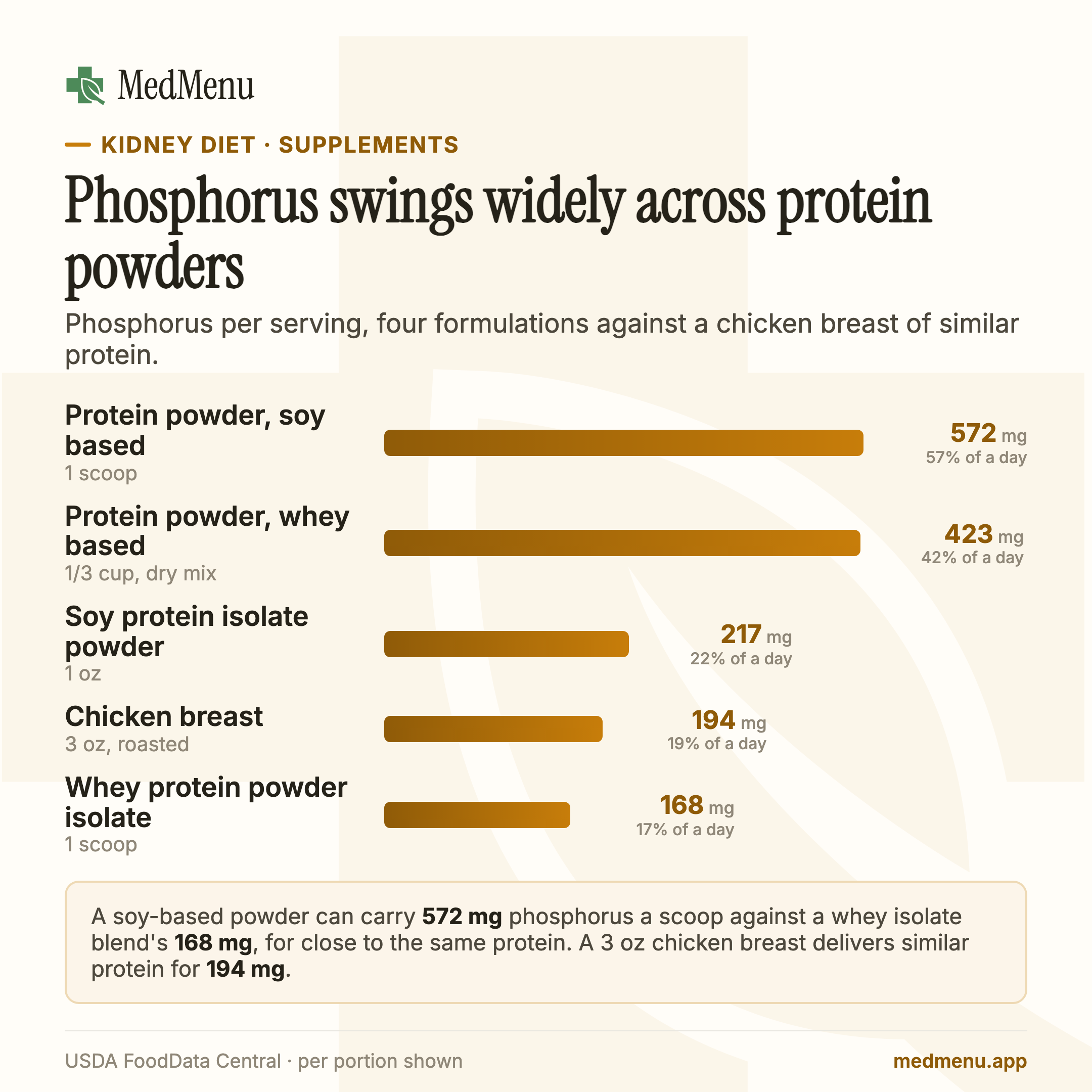
For someone with healthy kidneys, the evidence does not show that a high-protein habit, including from powder, causes harm. For someone with chronic kidney disease, the concern runs the other way, and there's a second layer this page adds: per USDA FoodData Central, four common formulations deliver roughly the same protein but very different amounts of phosphorus, potassium and sodium.
| Portion | Protein | Phosphorus | Potassium | Sodium |
|---|---|---|---|---|
| Protein powder, soy based, 1 scoop (45 g) | 25 g | 572 mg | 420 mg | 330 mg |
| Protein powder, whey based, 1/3 cup (32 g) | 25 g | 423 mg | 160 mg | 50 mg |
| Soy protein isolate powder, 1 oz (28 g) | 25 g | 217 mg | 23 mg | 281 mg |
| Whey protein powder isolate, 1 scoop (29 g) | 17 g | 168 mg | 253 mg | 108 mg |
| Chicken breast, 3 oz, roasted (85 g) | 26 g | 194 mg | 218 mg | 63 mg |
A common working reference for phosphorus on a kidney diet is around 1,000 mg a day, set from your own labs and stage rather than a universal cutoff.
For a similar 25 grams of protein, phosphorus swings from 168 mg to 572 mg across these four powders, more than a 3-fold spread, and potassium swings from 23 mg to 420 mg, nearly a 20-fold spread. A 3 oz chicken breast lands in the middle of that range for the phosphorus and sodium, while beating three of the four powders on potassium. For more whole-food protein options at this end of the scale, see our phosphorus in protein foods, ranked comparison.
In someone with normal kidney function, a study of body-builders and other well-trained athletes found no correlation between protein intake and creatinine clearance, albumin excretion rate, or calcium excretion rate, across intakes up to 2.8 grams per kilogram of body weight a day; every measure of kidney function stayed within the normal range (Poortmans and Dellalieux, 2000).
Chronic kidney disease changes that picture. The main clinical nutrition guideline for kidney disease recommends restricting protein rather than adding more of it: about 0.55 to 0.6 grams per kilogram of body weight a day for adults with CKD stage 3 to 5 who do not have diabetes, or 0.6 to 0.8 grams per kilogram where diabetes is also present, both under a doctor's supervision (Ikizler and colleagues, 2020). For a 70 kilogram (about 154 lb) adult, that works out to roughly 39 to 42 grams of protein a day without diabetes, or 42 to 56 grams with it, counting every source together, food and shakes combined. The soy-based powder in the table above is 25 grams a scoop by itself, over half that day's whole target before any food is eaten. A separate review of low-protein diets in CKD reaches a similar conclusion from a different angle: protein restriction in roughly this range may slow the pace of kidney function decline and delay the need for dialysis (Ko and colleagues, 2021).
If protein powder is part of your routine and you have CKD, naming it to your nephrologist or renal dietitian, and asking how it fits your specific target, is the plain next step.
Possibly, and separately from the raw phosphorus number. A small crossover trial in nine people with CKD found that one week on a vegetarian protein source produced lower serum phosphorus and lower FGF23 (a hormone that rises early as phosphorus balance shifts) than a meat-based diet carrying the same total phosphorus (Moe and colleagues, 2011). That trial tested whole-food vegetarian and meat diets, not isolated protein powders, and isolating a plant protein strips out much of the fiber and phytate that whole soybeans carry, so this page treats it as a directional signal about protein source rather than a settled claim that a soy-based powder inherits the same advantage as whole soy foods.
A related habit worth carrying into any manufactured food, protein powder included: a randomized trial in people on dialysis found that learning to spot phosphorus food additives on ingredient labels while shopping lowered serum phosphorus further over three months than usual care did (Sullivan and colleagues, 2009). That trial covered processed foods broadly, not protein powder specifically, so this page does not claim protein powder contains those additives; it is a general reason to read the ingredient list on any powder before buying it.
If you're also managing blood sugar, the same four powders vary on carbohydrate too: the soy-based mix carries 13 g a scoop against 2 g for the whey-based mix and 0 g for the soy isolate, a swing worth checking on the label alongside the mineral numbers. Our diabetic kidney disease diet guide covers both conditions together.
Protein, phosphorus, potassium and sodium figures for the four protein powders and chicken breast come from USDA FoodData Central (Standard Reference legacy), the same spine used across this site's kidney articles. The athlete study, the guideline, the low-protein-diet review, the vegetarian-protein trial and the additive-labeling trial are each cited at the level their published abstracts support; none gives a number this page does not state. This page names no dose or target to follow: your nephrologist and renal dietitian are the right people to set your protein target from your labs and stage.
Sources
MedMenu is an information tool, not medical advice, and does not diagnose, treat, or manage any condition. Your nephrologist and renal dietitian set your personal targets from your labs and stage. Published August 22, 2026 · Last updated August 22, 2026.
This is a comprehensive website! Recipes look great and represent a variety of cuisines. You have emphasized the appropriate nutrients. Guidance tips are helpful. Science tab provides evidence-based references and are appropriate for the diseases addressed. Links to Drugs.com, WebMD & Medline are nice. As a registered dietitian, I feel comfortable recommending MedMenu.
Susan G. Rodder, MS, RDN, LD
Registered Dietitian
MedMenu offers all the data you need to plan meals based on specific dietary needs. There are lot of great recipes from a variety of cuisines to choose from, or you can test your own recipe to see how well it fits into your dietary guidelines.
Valerie B.
MedMenu user
Diabetically Speaking with SmartMove360
It depends on kidney status more than the powder itself. A study of body-builders and other trained athletes found no relationship between protein intake, up to 2.8 grams per kilogram of body weight a day, and kidney function markers like creatinine clearance or albumin excretion; everyone stayed in the normal range. With chronic kidney disease, the concern runs the other way: the main nutrition guideline for CKD recommends less protein than an average diet, and a shake habit is easy to add on top of meals without noticing.
The main clinical nutrition guideline for kidney disease recommends about 0.55 to 0.6 grams per kilogram of body weight a day for adults with CKD stage 3 to 5 who do not have diabetes, or 0.6 to 0.8 grams per kilogram where diabetes is also present, both under a doctor's supervision. For a 70 kilogram adult, that is roughly 39 to 42 grams of protein a day without diabetes, or 42 to 56 grams with it, from every source combined. A single scoop of some protein powders carries 25 grams on its own, more than half that day's whole target before any food is eaten.
Yes, more than most people assume. Four common USDA-tracked protein powder formulations deliver roughly the same protein per serving, but phosphorus ranges from 168 to 572 mg, potassium from 23 to 420 mg, and sodium from 50 to 330 mg, spreads of 3 to nearly 20 times for a similar protein payout. A 3 oz chicken breast, for comparison, delivers similar protein for 194 mg phosphorus. A small trial also found that a vegetarian protein source produced lower serum phosphorus than a meat-based diet at the same total phosphorus, though that trial tested whole foods, not isolated powders.
Rather not count?
A printable week with the protein sources and their phosphorus, potassium and sodium already worked out for every meal.
See the meal plan →