Foods to avoid with kidney disease / Plant-based diet
"Plant-based" for kidney disease is more specific than the wellness phrase suggests. Researchers describe a plant-dominant low-protein diet, a controlled protein amount with more than half sourced from plants inside a fixed ceiling, rather than an open invitation to eat unlimited produce. And on raw milligrams, plant protein can run just as high in phosphorus as meat, sometimes higher; the real difference is how much of it the body absorbs.
By the MedMenu Editorial Team · Published August 23, 2026
Researchers have proposed and studied a specific version of this idea: a plant-dominant low-protein diet, often written PLADO, defined as roughly 0.6 to 0.8 grams of protein per kilogram of body weight a day, with more than half of that protein coming from plant sources, for conservative (non-dialysis) management of chronic kidney disease. The authors describe the proposed reasoning as lower internal pressure on the filtering units of the kidney, less nitrogenous waste for the kidney to clear, and a more favorable gut and cardiovascular profile, framed as proposed mechanisms in a narrative review rather than a proven outcome from a controlled trial (Kalantar-Zadeh and colleagues, 2020).
That definition matters because it rules out the common wellness-phrase version. It is not "eat mostly fruits and vegetables, freely." A 70 kilogram (about 154 lb) adult on the PLADO range would target roughly 42 to 56 grams of total protein a day, of which more than 21 to 28 grams should come from plant sources, a specific budget rather than an open door. Some plant foods also carry meaningful potassium; a half cup of white beans (505 mg) or kidney beans (359 mg) can carry more potassium than a 3 oz serving of salmon (326 mg) or chicken breast (218 mg), so "plant-based" on its own does not mean "lower in every mineral."
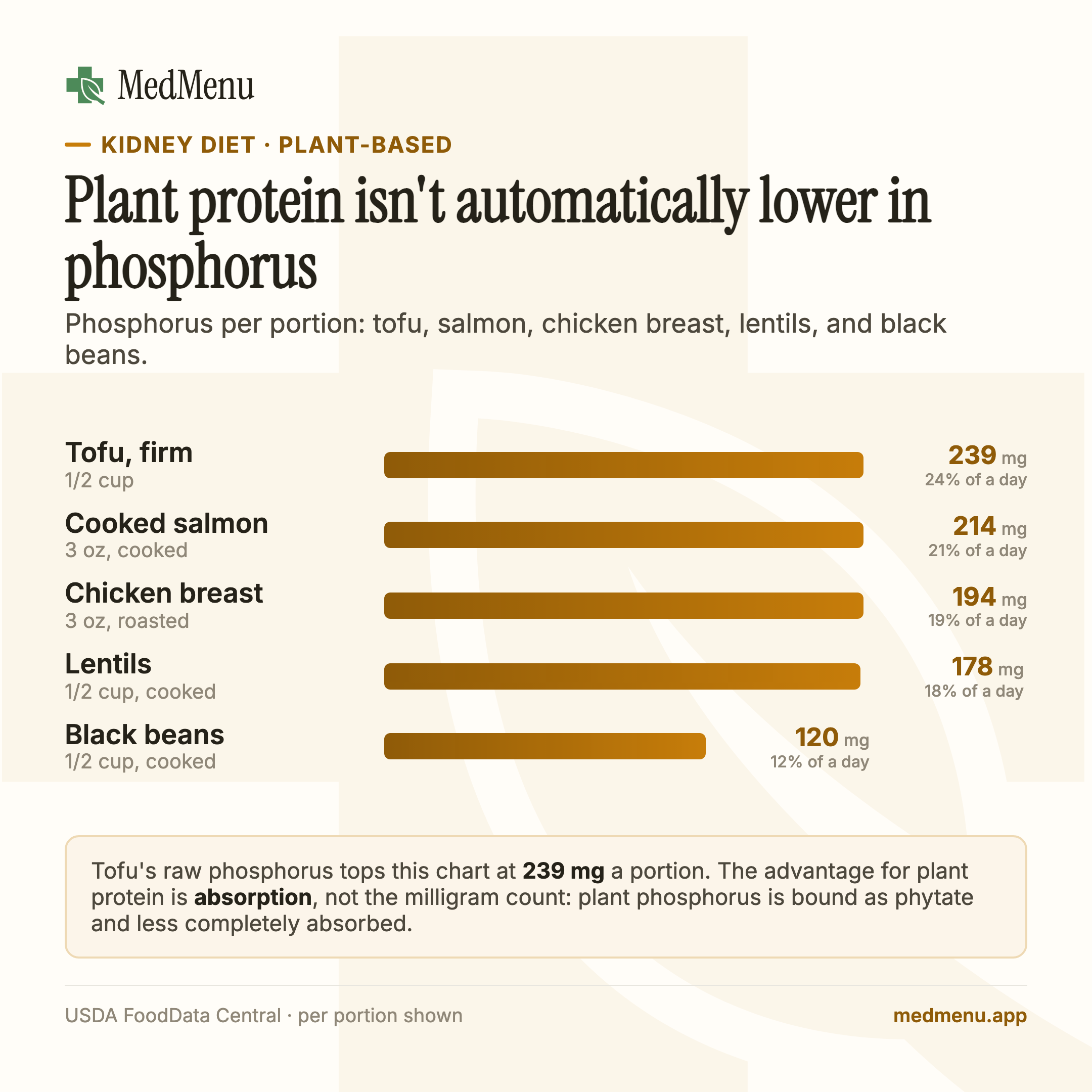
No. On the raw milligram count, tofu actually ranks highest, the genuinely new comparison this page adds to the site. Per USDA FoodData Central, a realistic portion of firm tofu carries more phosphorus than a similarly sized serving of chicken breast or salmon:
| Food, portion | Protein | Phosphorus |
|---|---|---|
| Tofu, firm, 1/2 cup (126 g) | 22 g | 239 mg |
| Cooked salmon, 3 oz (85 g) | 19 g | 214 mg |
| Chicken breast, 3 oz, roasted (85 g) | 26 g | 194 mg |
| Lentils, 1/2 cup, cooked (99 g) | 9 g | 178 mg |
| Black beans, 1/2 cup, cooked (86 g) | 8 g | 120 mg |
A common working reference for phosphorus on a kidney diet is around 1,000 mg a day, set from your own labs and stage rather than a universal cutoff.
Tofu tops this list; it is not the lowest. What favors plant sources is not the starting milligram count, it is what the body does with it afterward. A small crossover trial in nine people with chronic kidney disease found that one week on a vegetarian protein source produced lower serum phosphorus and lower FGF23, a hormone that rises early as phosphorus balance shifts, than a meat-based diet carrying the same total phosphorus (Moe and colleagues, 2011). Plant phosphorus is bound as phytate and less completely absorbed, roughly 20 to 50 percent absorption against roughly 40 to 60 percent for animal and dairy sources under the main CKD nutrition guideline. Also worth noting honestly: lentils and black beans deliver much less protein per portion than tofu, salmon or chicken (8 to 9 g against 19 to 26 g), so a plant-forward day in practice usually means combining several smaller plant portions across meals rather than making a single one-to-one swap.
Largely, yes, and it is worth checking rather than assuming. A direct read of MedMenu's own recipe library finds 950 recipes currently marked suitable for chronic kidney disease across its six supported cuisines. Of those, 855 (about 90 percent) are vegetarian by ingredient, and 461 (about 49 percent) contain no meat, seafood, egg, or dairy at all. The breakdown by cuisine (CKD-suitable recipes, vegetarian share of those) is Mediterranean 266 recipes at 93%, Indian 230 at 98%, Italian 185 at 96%, American 112 at 57%, Chinese 83 at 90%, and Mexican 61 at 84%.
This was not built by aiming for a plant-based product; it reflects that Mediterranean and Indian cooking, in particular, already lean on lentils, beans, and vegetables as everyday protein sources rather than treating them as a substitution. It is a description of the current library, not a claim about what any individual reader should eat; your nephrologist or renal dietitian sets your actual protein target and source mix. Browse suitable recipes by cuisine on the Food guides hub.
Plant protein sources tend to arrive with fiber that slows a blood sugar rise, which is a second reason the PLADO framing and a diabetes-aware kidney diet tend to point the same direction. Lentils carry a glycemic index around 24 and black beans are also low-GI, both well under a starchy staple like white rice at 73. That is a food-choice detail, not a claim that either food manages blood sugar on its own; see our diabetic kidney disease diet guide for the fuller picture of managing both conditions together.
Protein, phosphorus and potassium figures for tofu, salmon, chicken breast, lentils, black beans, white beans and kidney beans come from USDA FoodData Central (Standard Reference legacy), the same spine used across this site's kidney articles. The PLADO definition and its proposed mechanisms are quoted at the level the cited narrative review actually supports, framed as a proposed approach rather than a proven outcome. The recipe-library figures come from a direct query of MedMenu's own recipe database, current as of this page's last update. This page names no protein target to follow: your nephrologist and renal dietitian are the right people to set your protein amount and source mix from your labs and stage.
Sources
MedMenu is an information tool, not medical advice, and does not diagnose, treat, or manage any condition. Your nephrologist and renal dietitian set your personal protein target and source mix from your labs and stage. Published August 23, 2026 · Last updated August 23, 2026.
This is a comprehensive website! Recipes look great and represent a variety of cuisines. You have emphasized the appropriate nutrients. Guidance tips are helpful. Science tab provides evidence-based references and are appropriate for the diseases addressed. Links to Drugs.com, WebMD & Medline are nice. As a registered dietitian, I feel comfortable recommending MedMenu.
Susan G. Rodder, MS, RDN, LD
Registered Dietitian
MedMenu offers all the data you need to plan meals based on specific dietary needs. There are lot of great recipes from a variety of cuisines to choose from, or you can test your own recipe to see how well it fits into your dietary guidelines.
Valerie B.
MedMenu user
Diabetically Speaking with SmartMove360
The studied version is narrower than the phrase suggests. Researchers describe a plant-dominant low-protein diet, sometimes shortened to PLADO, as a controlled total protein intake of 0.6 to 0.8 grams per kilogram of body weight a day where more than half of that protein comes from plant sources, proposed for conservative management of chronic kidney disease before dialysis. That is a specific amount and source mix inside a fixed protein ceiling, rather than an open invitation to eat unlimited fruits and vegetables, some of which carry more potassium than the animal foods they might replace.
No. On the raw milligram count, a half cup of firm tofu actually carries more phosphorus (239 mg) than a 3 oz chicken breast (194 mg) or a 3 oz serving of salmon (214 mg). The documented advantage of plant protein sources is not a lower starting number, it is that a small trial found plant-source phosphorus produced a lower serum phosphorus result than an equal amount of meat-source phosphorus, because plant phosphorus is bound as phytate and less completely absorbed by the body.
Largely, yes, and it was not built as a plant-based product first. Of the recipes in MedMenu's library currently marked suitable for chronic kidney disease, about 90 percent are vegetarian by ingredient, across all six supported cuisines including Mediterranean, Indian, and Italian, cuisines that lean naturally toward lentils, beans, and vegetables as everyday protein sources.
Rather not count?
A printable week of plant-based, stage 3-4 kidney-friendly meals with the protein sources and their phosphorus, potassium and sodium already worked out.
See the meal plan →