Foods to avoid with kidney disease / Lemon water
The real evidence is about kidney stones, not chronic kidney disease. In small clinical studies, people with a history of low-citrate calcium stones who drank lemon juice mixed with water every day raised a stone-resisting compound in their urine and, over years of follow-up, formed fewer stones. That is a specific finding in a specific condition. It is not evidence that lemon water changes kidney function, and by itself the drink carries almost no potassium, phosphorus or sodium to worry about either way. This page walks through both questions separately, with the actual numbers behind each.
By the MedMenu Editorial Team · Published August 20, 2026
For one specific type of stone, the evidence is real, even though the studies are small. Urinary citrate is a natural compound that binds calcium in urine and keeps it from crystallizing into stones; people with recurrently low citrate (hypocitraturia) are prone to calcium stones. Two published studies tested lemon juice as a citrate source:
| Study | Design | Finding |
|---|---|---|
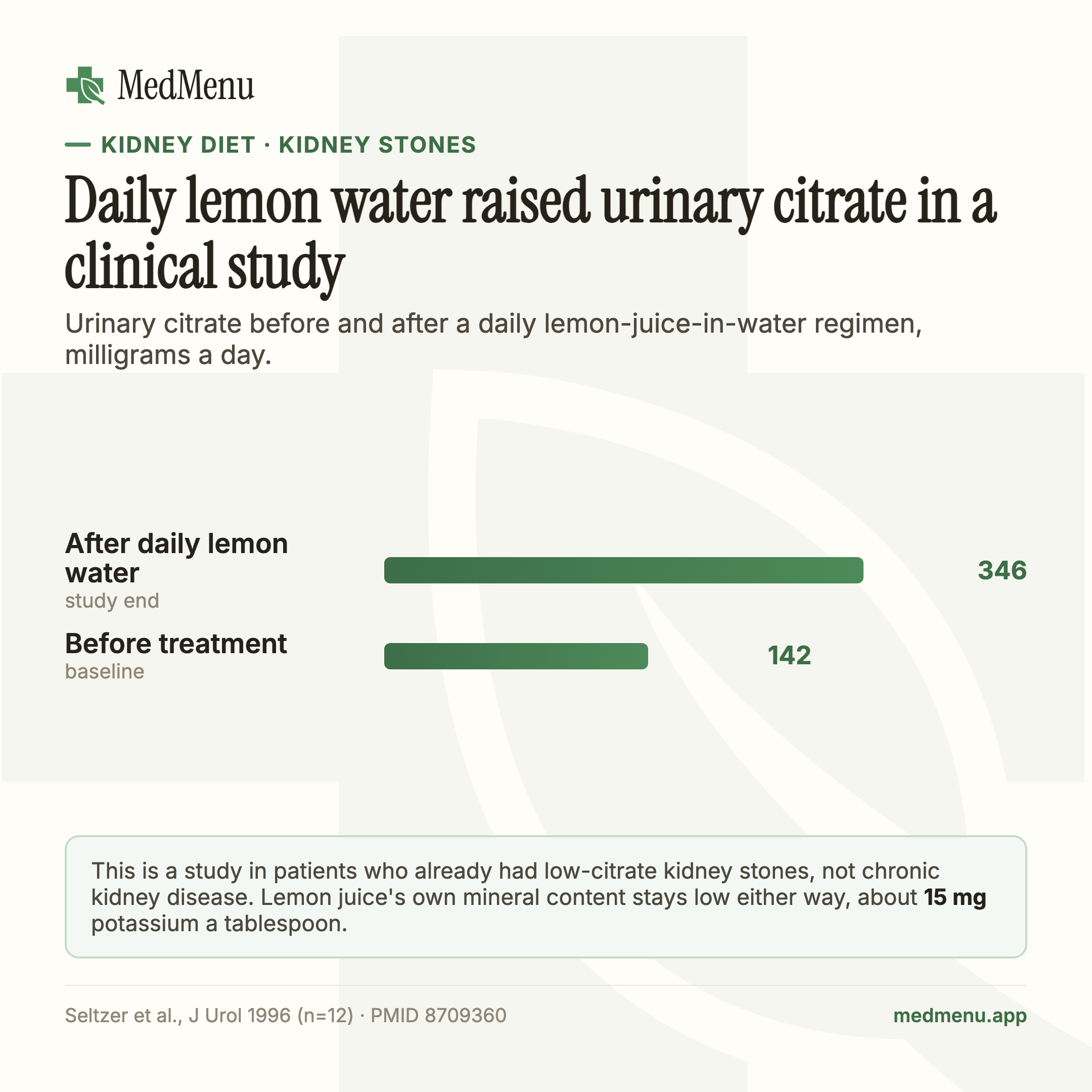
| Seltzer et al., 1996 | 12 patients, daily lemon juice in water | Urinary citrate rose from 142 to 346 mg a day (p<0.001); 7 of 12 reached a normal range |
| Kang et al., 2007 | 11 patients, mean 44.4 months follow-up | Stone formation rate fell from 1.00 to 0.13 stones per patient per year |
The regimen in the first study was specific: about 4 ounces of reconstituted lemon juice mixed into 2 liters of water, taken daily, a measured routine rather than a wedge squeezed into a single glass.
Neither study was blinded or randomized against a placebo, and both enrolled patients who already had documented low citrate and recurrent stones, a narrower group than "anyone who drinks lemon water." Within that group, though, the citrate response and the drop in stone formation rate are genuine, published findings, not folklore. If you have a history of kidney stones, this is a real conversation to have with your urologist rather than something to try on your own.
A different question, and the numbers point somewhere else entirely. Kidneys already filter blood continuously on their own; no food or drink adds extra clearing capacity, and no study above measured kidney function itself, only urine chemistry in stone-forming patients. By the numbers, per USDA FoodData Central:
| Portion | Potassium | Phosphorus | Sodium |
|---|---|---|---|
| Lemon juice, 1 tbsp (15 g) | 15 mg | 1 mg | 0 mg |
| Banana, 1 medium (118 g), for scale | 422 mg | 26 mg | 1 mg |
Squeezing a whole lemon into a pitcher barely moves those numbers; the amount most people call "lemon water" stays in the same negligible range as a splash of vinegar or a squeeze of lime. The dose used in the stone studies is a different thing: several ounces of concentrated juice in 2 liters of water, every day, a real volume of fluid worth mentioning to your care team if you're on a fluid restriction at a later CKD stage. A doctor treating stones might reach for potassium citrate as a tablet instead, which carries a real, medically dosed amount of potassium and needs regular blood-work monitoring, a different thing entirely from food-form juice.
Fluid and electrolyte targets in kidney disease come from your own labs and stage, set individually rather than from one number that applies to everyone.
Unsweetened lemon water carries almost no carbohydrate on its own, about 1 g per tablespoon of juice, which is functionally sugar-free. The meaningful blood-sugar difference is what people add to it: a squeeze of lemon in plain water is a straightforward swap for a can of soda or a glass of sweetened lemonade, both of which carry real added sugar that lemon water does not. Where kidney disease and diabetes overlap, the fuller picture is in our diabetic kidney disease diet guide.
Potassium, phosphorus, sodium and carbohydrate figures for lemon juice and banana come from USDA FoodData Central (Standard Reference legacy), the same spine used across this site's kidney articles. Both clinical studies are quoted from their own published abstracts as reported, with sample sizes and study design stated alongside every number so the findings aren't read as stronger than they are. This page names no dose or regimen to follow: a urologist is the right person to weigh a citrate strategy against your own stone history and labs, and a nephrologist or renal dietitian is the right person to weigh fluid and electrolyte questions against your CKD stage.
Sources
MedMenu is an information tool, not medical advice, and does not diagnose, treat, or manage any condition. Your urologist, nephrologist, or renal dietitian set your personal targets from your history, labs, and stage. Published August 20, 2026 · Last updated August 20, 2026.
This is a comprehensive website! Recipes look great and represent a variety of cuisines. You have emphasized the appropriate nutrients. Guidance tips are helpful. Science tab provides evidence-based references and are appropriate for the diseases addressed. Links to Drugs.com, WebMD & Medline are nice. As a registered dietitian, I feel comfortable recommending MedMenu.
Susan G. Rodder, MS, RDN, LD
Registered Dietitian
MedMenu offers all the data you need to plan meals based on specific dietary needs. There are lot of great recipes from a variety of cuisines to choose from, or you can test your own recipe to see how well it fits into your dietary guidelines.
Valerie B.
MedMenu user
Diabetically Speaking with SmartMove360
It depends which question you're actually asking. If you mean kidney stones, two small clinical studies found that a daily lemon-juice-in-water regimen raised urinary citrate, a compound that resists stone formation, and was linked to fewer stones forming over time. If you mean chronic kidney disease, there is no published evidence that lemon water changes kidney function, and its own mineral content is too small to matter either way. Those are two different conditions, and the evidence only supports one of them.
In small studies, yes, for a specific type. In 12 patients with low urinary citrate and recurrent calcium stones, a daily regimen of about 4 ounces of lemon juice in 2 liters of water raised urinary citrate from 142 to 346 milligrams a day. A longer follow-up study in 11 similar patients, averaged over 44 months, found the stone formation rate fell from 1.00 to 0.13 stones per patient per year. Both studies are small and uncontrolled, and both apply specifically to hypocitraturic stone formers rather than a general population.
By the numbers, lemon juice barely registers: about 15 mg potassium, 1 mg phosphorus and 0 mg sodium per tablespoon, next to nothing against a medium banana's 422 mg potassium. The regimen in the stone studies is a different matter, several ounces of concentrated juice in 2 liters of water daily, a real fluid volume worth mentioning to your care team if you're on a fluid restriction. A doctor may also prescribe potassium citrate as a tablet for the same reason, which is a meaningful potassium dose and needs blood-level monitoring, unlike squeezing an actual lemon.
Rather not count?
A printable week with the potassium, phosphorus and sodium worked out for every meal and drink, so the portions are handled for you.
See the meal plan →