Foods to avoid with kidney disease / Apple cider vinegar
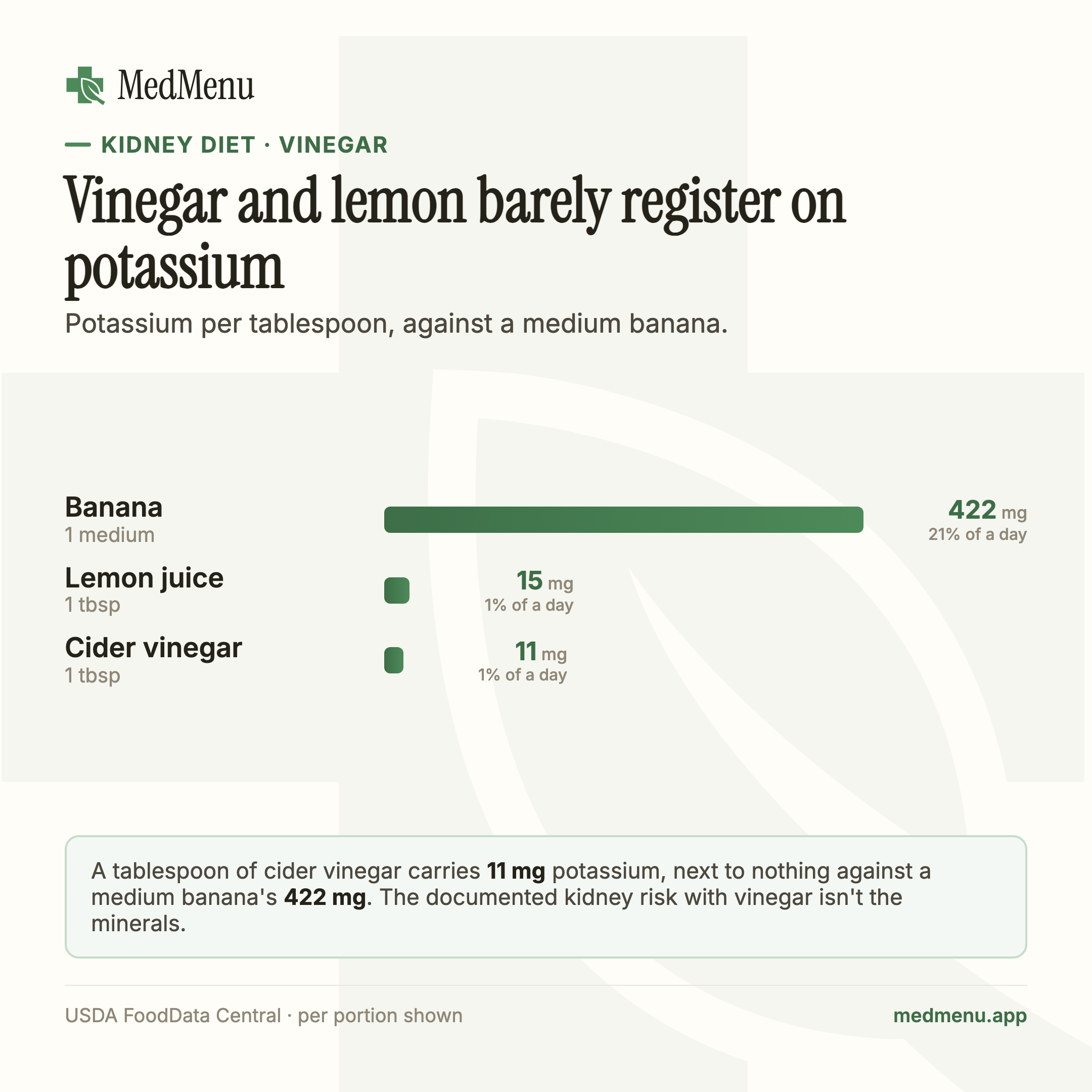
By the numbers, cider vinegar is one of the lowest-mineral items in the pantry. A tablespoon carries about 11 mg potassium, 1 mg phosphorus and 1 mg sodium, next to nothing against a medium banana's 422 mg potassium. So the mineral-content fear that drives most "is X bad for kidneys" questions doesn't really apply here. The documented kidney risk sits somewhere else: a published case report shows that heavy, years-long vinegar drinking can cause real harm through a completely different mechanism, one that runs in the opposite direction from what a potassium-counting reader would expect. This page separates the two questions.
By the MedMenu Editorial Team · Published August 18, 2026
Not on mineral content. Per USDA FoodData Central, a normal culinary serving looks like this:
| Portion | Potassium | Phosphorus | Sodium |
|---|---|---|---|
| Cider vinegar, 1 tbsp (15 g) | 11 mg | 1 mg | 1 mg |
| Lemon juice, 1 tbsp | 15 mg | 1 mg | 0 mg |
| Banana, 1 medium (118 g), for scale | 422 mg | 26 mg | 1 mg |
Even two tablespoons a day of cider vinegar, a common dose in the research on blood sugar below, adds up to about 22 mg potassium, under a twentieth of a single banana and well inside any working reference for a day's intake (many kidney diets use around 2,000 mg potassium a day as a common working point).
Lemon juice and cider vinegar do the same job at the table, cutting the urge to reach for salt, and both are already the acid pairing in our low-sodium kidney diet guide. Neither belongs on a list of foods to count. Lemon juice has a separate story of its own, though, in what a daily lemon-water regimen has shown for kidney stones.
It runs the opposite direction from a mineral-content fear. A published case report describes a patient who regularly drank large amounts of cider vinegar and was hospitalized with hypokalemia, hyperreninemia and osteoporosis (Lhotta and colleagues, 1998). That is dangerously LOW blood potassium, not high, the opposite of what most kidney-diet content warns about. The vinegar's own potassium content had nothing to do with it, there is almost none in vinegar to begin with. The mechanism runs through how the body processes the acid itself: the kidney's handling of that acid load can increase how much potassium leaves in the urine, and heavy, sustained intake is what turned that into a hospital admission.
A normal cooking or salad-dressing amount of vinegar is not the pattern described in the published case; the case is about years of heavy, regular drinking, a different thing from seasoning food with it.
Modestly, and the evidence is more current than most vinegar claims online. A 2025 systematic review and dose-response meta-analysis pooling 7 controlled trials in people with type 2 diabetes found apple cider vinegar significantly lowered fasting blood sugar (by about 22 mg/dL on average) and HbA1c (by about 1.5 percentage points), with a dose-response pattern: the effect scaled with the amount consumed, and was strongest above 10 mL a day, roughly two-thirds of a tablespoon (Arjmandfard and colleagues, 2025). The same analysis found no significant effect on insulin resistance itself, a real limit on how the finding should be read.
That is a genuine, bounded result that sits alongside the medications and eating pattern your care team has already set. It changes nothing about the potassium arithmetic above: the doses studied stay in the same negligible-mineral range as an ordinary tablespoon. Where kidney disease and diabetes travel together, the fuller picture is in our diabetic kidney disease diet guide.
Potassium, phosphorus and sodium figures for cider vinegar, lemon juice and banana come from USDA FoodData Central (Standard Reference legacy), the same spine used across this site's kidney articles. The case report is cited at the level its indexed record supports: PubMed and Europe PMC carry no abstract for this 1998 letter, so this page states the documented clinical picture named in the title (hypokalemia, hyperreninemia, osteoporosis) without asserting specific lab values or a duration that could not be confirmed against a primary source. The meta-analysis figures are quoted from its own abstract as published. This page names no dose to take: your nephrologist and renal dietitian are the right people to weigh a vinegar habit against your labs and stage.
Sources
MedMenu is an information tool, not medical advice, and does not diagnose, treat, or manage any condition. Your nephrologist and renal dietitian set your personal targets from your labs and stage. Published August 18, 2026 · Last updated August 18, 2026.
This is a comprehensive website! Recipes look great and represent a variety of cuisines. You have emphasized the appropriate nutrients. Guidance tips are helpful. Science tab provides evidence-based references and are appropriate for the diseases addressed. Links to Drugs.com, WebMD & Medline are nice. As a registered dietitian, I feel comfortable recommending MedMenu.
Susan G. Rodder, MS, RDN, LD
Registered Dietitian
MedMenu offers all the data you need to plan meals based on specific dietary needs. There are lot of great recipes from a variety of cuisines to choose from, or you can test your own recipe to see how well it fits into your dietary guidelines.
Valerie B.
MedMenu user
Diabetically Speaking with SmartMove360
Not because of its minerals. A tablespoon of cider vinegar carries about 11 mg potassium, 1 mg phosphorus and 1 mg sodium, close to nothing against a medium banana's 422 mg potassium or a slice of bread's phosphorus. Lemon juice, the other acid people reach for instead of salt, sits in the same negligible range. If your concern is potassium or phosphorus content, a normal culinary dose of vinegar is not where that concern belongs.
Dose and habit, not nutrient content. A published case report describes a patient who regularly drank large amounts of cider vinegar and was hospitalized with hypokalemia, hyperreninemia and osteoporosis, a case where heavy, sustained vinegar drinking caused dangerously low potassium, the opposite direction from the high-potassium foods most kidney-diet content warns about. The mechanism runs through how the body processes the acid itself, not through vinegar's own mineral content, which stays negligible however much is used. This is not a reason to avoid a normal serving; it is a reason a vinegar-drinking habit, at volumes and durations far past cooking use, is worth mentioning to your care team.
The evidence points to a real, modest effect. A 2025 meta-analysis pooling 7 controlled trials found apple cider vinegar significantly lowered fasting blood sugar and HbA1c in people with type 2 diabetes, with a dose-response relationship; larger effects were seen above 10 mL a day, roughly two-thirds of a tablespoon. The same analysis found no significant effect on insulin resistance itself. That is a real, bounded finding worth discussing with your care team, not a substitute for medication or a documented treatment.
Rather not count?
A printable week with the potassium, phosphorus and sodium worked out for every meal and drink, so the portions are handled for you.
See the meal plan →