Foods to avoid with kidney disease / Turmeric
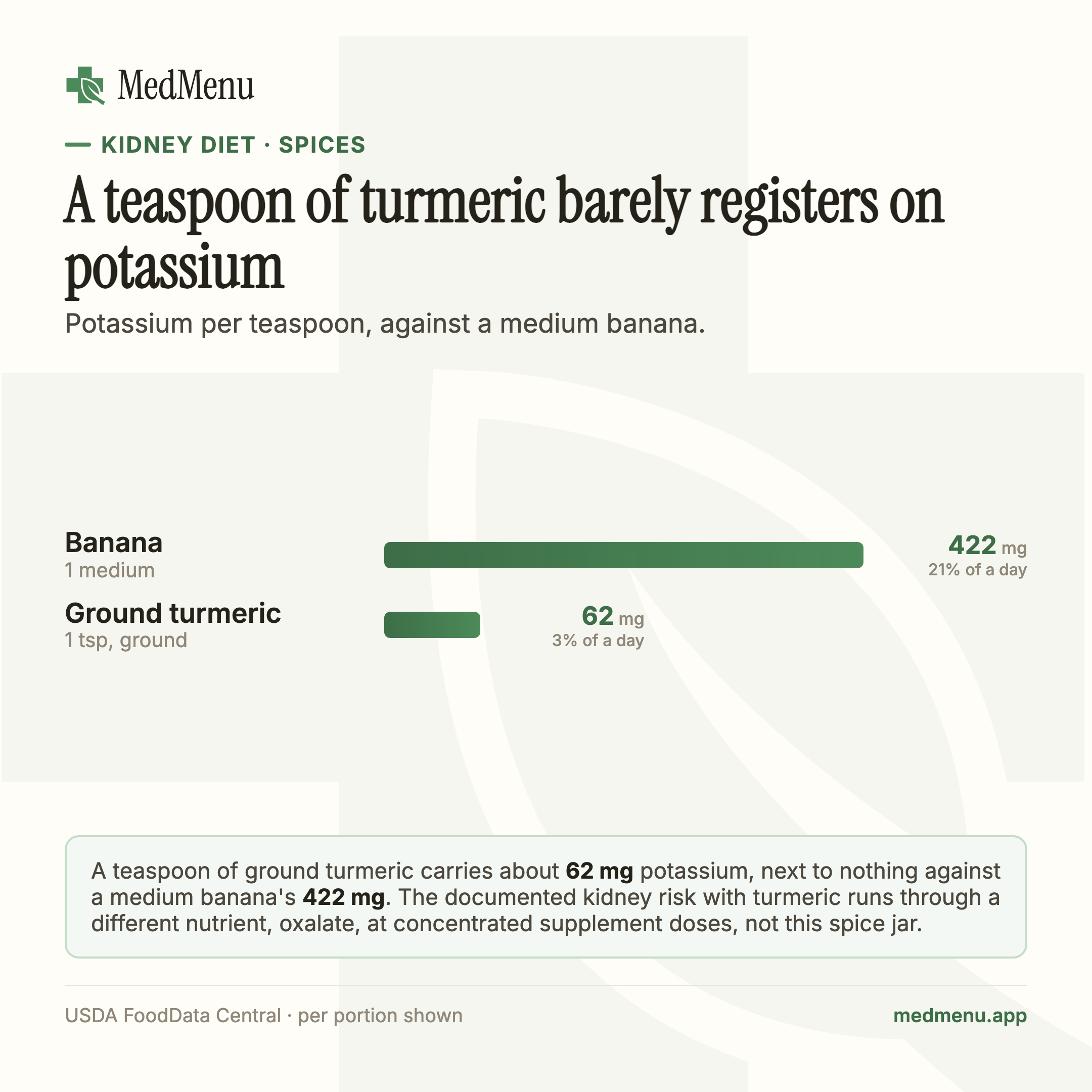
By the numbers, a spoonful of turmeric barely registers as a mineral source. A teaspoon of the ground spice carries about 62 mg potassium, 9 mg phosphorus and 1 mg sodium, nowhere close to a medium banana's 422 mg potassium. So the mineral-counting fear behind most "is X bad for kidneys" questions doesn't really apply to the spice jar. The documented kidney risk sits somewhere else entirely: a published case report and a supplement-testing study both point to oxalate, a nutrient this site hasn't had reason to track before, showing up at chronic supplement doses well past what cooking with turmeric involves. This page separates the two.
By the MedMenu Editorial Team · Published August 21, 2026
Not on mineral content. Per USDA FoodData Central, a normal culinary serving looks like this:
| Portion | Potassium | Phosphorus | Sodium |
|---|---|---|---|
| Ground turmeric, 1 tsp (3 g) | 62 mg | 9 mg | 1 mg |
| A heavy tablespoon of turmeric (9.4 g), more than most curries use | 196 mg | 28 mg | 3 mg |
| Banana, 1 medium (118 g), for scale | 422 mg | 26 mg | 1 mg |
Even a full tablespoon, more than most recipes call for, stays under 200 mg potassium, well inside any working reference for a day's intake (many kidney diets use around 2,000 mg potassium a day as a common working point).
This is the same story this site has found with other pantry staples used in small doses, like the acids covered in our apple cider vinegar and kidneys guide: a food can be a genuine flavor workhorse without registering as a mineral concern. Where turmeric differs is what happens at doses far past cooking.
It runs through a nutrient this site hasn't had reason to cover before: oxalate, the same substance most kidney stones are built from. A published 2024 case report describes a 69-year-old man diagnosed with oxalate nephropathy, kidney damage caused by oxalate crystals lodging in kidney tissue, in the setting of chronic turmeric supplementation combined with antibiotic-related diarrhea (Washington and colleagues, 2024). Diarrhea is its own separate, independent driver of oxalate absorption, so the case names two compounding factors together, not turmeric supplementation on its own. The kidney failure was found incidentally on a routine check-up; the report notes that diagnosing this pattern takes "a high index of clinical suspicion" and that even a single oxalate crystal on a kidney biopsy is considered a pathological finding.
A separate 2026 study adds a concrete number: researchers directly measured the oxalate content of bestselling turmeric, chanca piedra, and cinnamon supplements marketed for kidney stone prevention, using laboratory chromatography rather than label claims, and found the turmeric product carried about 8.6 mg of oxalate per dose (Thaker and colleagues, 2026). That figure describes a concentrated supplement product taken daily over time, a different scale entirely from a pinch of the spice in a pot of dal. No verified source measures meaningful oxalate in an ordinary culinary dose of ground turmeric, and this page does not assert one.
Cooking with turmeric is not the pattern described in either source above; both describe concentrated, sustained supplement use, a different thing from seasoning a dish with it.
The honest answer is mixed, and the most current evidence looks directly at the diabetes-and-kidney overlap rather than blood sugar alone. A 2026 systematic review and meta-analysis pooling 12 randomized controlled trials in 1,303 people with diabetes examined what curcumin and turmeric supplementation actually do to kidney function markers (Bahari and Asadi, 2026). It found a significant reduction in blood urea, but no significant change in creatinine, BUN, uric acid, or albumin, the measures that more directly track how well the kidneys are filtering.
| Kidney marker | Effect of curcumin/turmeric | Statistically significant? |
|---|---|---|
| Urea | −2.53 mg/dL | Yes (p=0.002) |
| Uric acid | −1.46 mg/dL | Trend only (p=0.053) |
| Creatinine | −0.01 mg/dL | No (p=0.519) |
| BUN | −0.41 mg/dL | No (p=0.769) |
| Albumin | +0.07 g/dL | No (p=0.133) |
Read plainly, that is a real but bounded result: one lab value moved, and the markers doctors lean on more heavily for kidney function itself did not. It sits alongside, not in place of, the eating pattern and medications your care team has already set. For the fuller combined picture, our diabetic kidney disease diet guide covers both conditions at once.
Potassium, phosphorus and sodium figures for turmeric and banana come from USDA FoodData Central (Standard Reference legacy), the same spine used across this site's kidney articles. The case report and the supplement-oxalate study are cited at the level their published abstracts support: neither gives a specific turmeric dose or duration for the case, so this page does not assert those. The meta-analysis figures are quoted from its own abstract as published. This page names no dose to take or avoid: your nephrologist and renal dietitian are the right people to weigh a turmeric or curcumin supplement against your labs and stage.
Sources
MedMenu is an information tool, not medical advice, and does not diagnose, treat, or manage any condition. Your nephrologist and renal dietitian set your personal targets from your labs and stage. Published August 21, 2026 · Last updated August 21, 2026.
This is a comprehensive website! Recipes look great and represent a variety of cuisines. You have emphasized the appropriate nutrients. Guidance tips are helpful. Science tab provides evidence-based references and are appropriate for the diseases addressed. Links to Drugs.com, WebMD & Medline are nice. As a registered dietitian, I feel comfortable recommending MedMenu.
Susan G. Rodder, MS, RDN, LD
Registered Dietitian
MedMenu offers all the data you need to plan meals based on specific dietary needs. There are lot of great recipes from a variety of cuisines to choose from, or you can test your own recipe to see how well it fits into your dietary guidelines.
Valerie B.
MedMenu user
Diabetically Speaking with SmartMove360
Not because of its minerals. A teaspoon of ground turmeric carries about 62 mg potassium, 9 mg phosphorus and 1 mg sodium, close to nothing against a medium banana's 422 mg potassium. Even a heavier tablespoon in a curry stays under 200 mg potassium. If your concern is potassium or phosphorus content, an ordinary culinary amount of turmeric is not where that concern belongs.
A different nutrient entirely: oxalate, at chronic supplement doses. A published 2024 case report describes a 69-year-old man diagnosed with oxalate nephropathy in the setting of chronic turmeric supplementation combined with antibiotic-related diarrhea, two compounding factors, not turmeric alone. A separate 2026 study that directly measured bestselling kidney-stone supplements sold online found a turmeric product carrying 8.6 mg of oxalate per dose. Both findings are about concentrated supplement products, not cooking with the spice; no verified source measures meaningful oxalate in an ordinary culinary teaspoon of turmeric.
The evidence is honest and mixed. A 2026 meta-analysis pooling 12 randomized controlled trials in 1,303 people with diabetes found curcumin/turmeric supplementation significantly reduced blood urea, but did not significantly change creatinine, BUN, uric acid, or albumin, the markers that more directly track kidney function. That is a real but limited finding: it moves one lab value without moving the harder measures of how well the kidneys are working.
Rather not count?
A printable week with the potassium, phosphorus and sodium worked out for every meal and drink, so the portions are handled for you.
See the meal plan →