Foods to avoid with kidney disease / Magnesium
They are two different questions with two different answers. The federal fact sheet on magnesium sets an upper limit that covers supplements and medications only, so food-level magnesium keeps moving through as long as your kidneys still filter reasonably well. The documented toxicity risk sits somewhere else entirely: large doses of magnesium-containing laxatives and antacids, the kind sold over the counter for constipation or heartburn, have caused real harm, and reduced kidney function is exactly what removes the safety margin those products rely on. This page maps both sides, food and supplement, so the two do not get confused for one another.
By the MedMenu Editorial Team · Published August 15, 2026
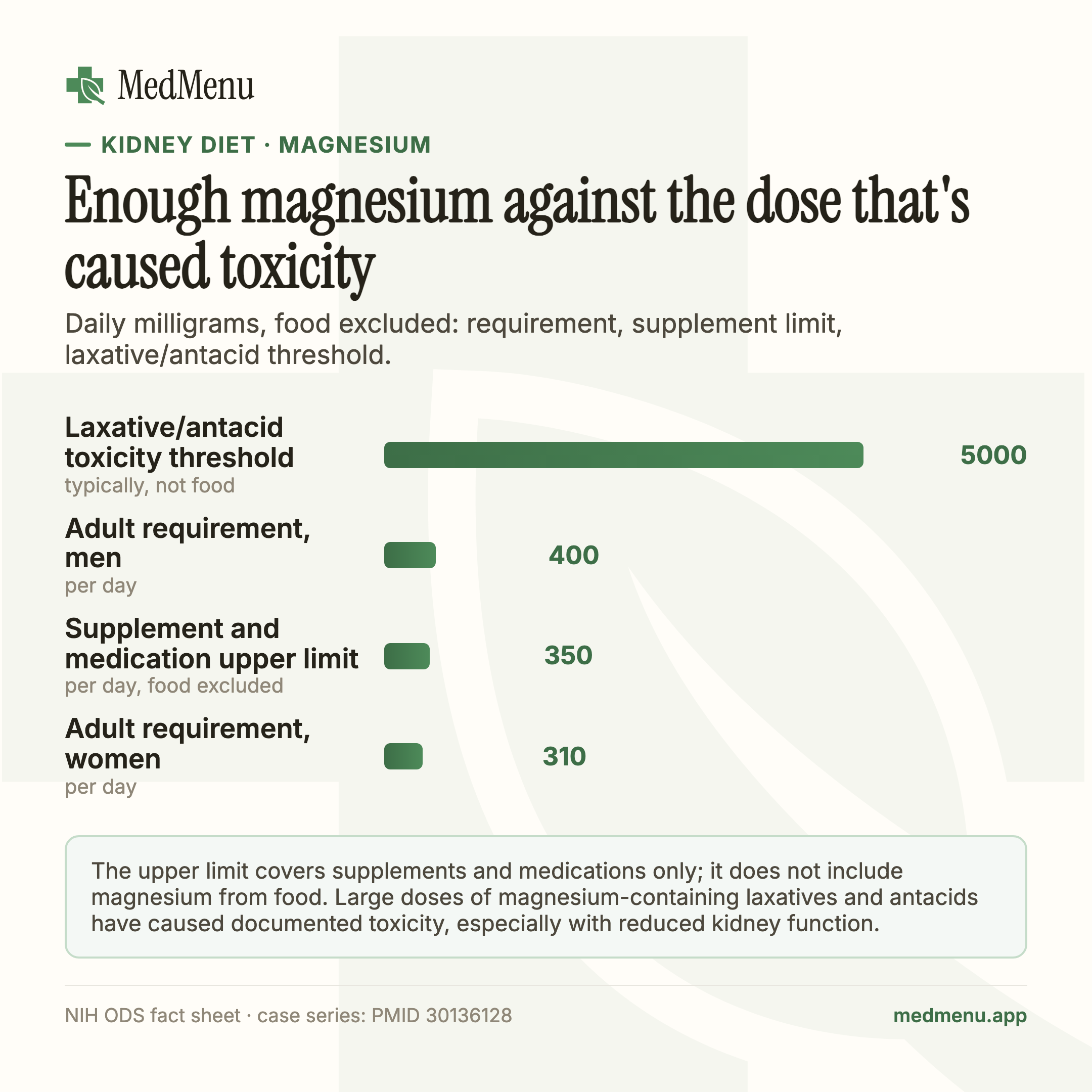
Usually not, and that puts magnesium in a different category from potassium and phosphorus on this site. The NIH Office of Dietary Supplements sets an adult upper limit of 350 mg a day, and states plainly that the figure covers magnesium from supplements and medications only: it does not include magnesium found naturally in food and beverages. An adult diet typically supplies around 400 mg a day for men and 310 mg a day for women, and kidneys that still filter reasonably well keep clearing what the body does not need.
The foods that carry the most magnesium are, by portion, on this table:
| Portion | Magnesium |
|---|---|
| Almonds, 1 oz (28 g) | 76 mg |
| Cooked spinach, 1/2 cup (90 g) | 78 mg |
| Kidney beans, 1/2 cup, cooked (89 g) | 40 mg |
| Whole-wheat bread, 1 slice (28 g) | 21 mg |
| Banana, 1 medium (118 g), for reference | 32 mg |
Every one of these top rows is a food this site already discusses for a different reason: almonds and beans for potassium and phosphorus, cooked spinach for potassium, whole-wheat bread for phosphorus. Magnesium is not an additional reason to cut any of them for most people with earlier-stage kidney disease; it rides along with minerals already being tracked.
From the medicine cabinet. Very large doses of magnesium-containing laxatives and antacids, typically ones supplying more than 5,000 mg of magnesium a day, have been linked to magnesium toxicity, including fatal cases in both children and older adults. A 2019 case series described four elderly patients with reduced kidney function who developed symptomatic hypermagnesemia after taking magnesium oxide, a common laxative ingredient; several had trouble reporting symptoms because of cerebrovascular disease or dementia, and one case was fatal (Yamaguchi and colleagues, 2019).
The mechanism is the same one that makes food magnesium a non-issue for most people: clearance. Kidneys that filter well export the surplus. As kidney function declines, that export slows, and the NIH fact sheet states the risk of magnesium toxicity rises specifically because "the ability to remove excess magnesium is reduced or lost."
Everyday multivitamins and typical antacid doses are not the products described in these cases; the pattern in the published reports is a large, sustained laxative or antacid dose meeting a kidney that can no longer keep up.
Here the evidence leans favorable, with a real caveat attached. Diets higher in magnesium are associated with a lower risk of type 2 diabetes; one meta-analysis cited by the NIH fact sheet found that each 100 mg a day of additional magnesium intake corresponded to about a 15% lower diabetes risk. That is an association from observational studies, and the fact sheet names the limitation directly: other dietary, lifestyle or environmental factors that travel alongside magnesium intake could account for some of the effect. The American Diabetes Association's own position follows from that limitation: there is insufficient evidence to support routinely using magnesium supplements to improve glucose control, and clinical trials testing magnesium supplementation for blood sugar have produced conflicting results.
The practical version is food-first rather than supplement-first: the same beans, whole grains and leafy greens that carry magnesium already show up in a kidney-and-diabetes eating pattern for other reasons, worked through portion by portion in our diabetic kidney disease diet guide.
Magnesium figures for almonds, cooked spinach, kidney beans, whole-wheat bread and banana come from USDA FoodData Central (Standard Reference legacy), the same spine used across this site's kidney articles. Requirement, upper-limit and toxicity-threshold figures come from the NIH Office of Dietary Supplements fact sheet, fetched live. The case series is quoted as published, with details attributed to a study of four patients rather than generalized. This page names no supplement or laxative to take or avoid: your nephrologist and pharmacist are the right people to review your specific products against your kidney function.
Sources
MedMenu is an information tool, not medical advice, and does not diagnose, treat, or manage any condition. Your nephrologist, pharmacist and renal dietitian set your personal targets and review your specific medications and supplements against your labs and stage. Published August 15, 2026 · Last updated August 15, 2026.
This is a comprehensive website! Recipes look great and represent a variety of cuisines. You have emphasized the appropriate nutrients. Guidance tips are helpful. Science tab provides evidence-based references and are appropriate for the diseases addressed. Links to Drugs.com, WebMD & Medline are nice. As a registered dietitian, I feel comfortable recommending MedMenu.
Susan G. Rodder, MS, RDN, LD
Registered Dietitian
MedMenu offers all the data you need to plan meals based on specific dietary needs. There are lot of great recipes from a variety of cuisines to choose from, or you can test your own recipe to see how well it fits into your dietary guidelines.
Valerie B.
MedMenu user
Diabetically Speaking with SmartMove360
Not the way potassium and phosphorus are. The official upper limit for magnesium covers supplements and medications only; the federal fact sheet is explicit that it does not include magnesium found naturally in food and beverages. Kidneys that still filter reasonably well keep clearing the extra magnesium a normal diet supplies. That is why almonds, cooked spinach, beans and whole-wheat bread, foods already discussed on this site for potassium or phosphorus, are not treated as a separate magnesium-restricted list here.
The medicine cabinet, not the pantry. Very large doses of magnesium-containing laxatives and antacids, the kind that supply more than 5,000 mg of magnesium a day, have been linked to magnesium toxicity, including fatal cases. A 2019 case series described four elderly patients with reduced kidney function who developed symptomatic hypermagnesemia after taking magnesium oxide, a common laxative ingredient; one case was fatal. The mechanism is clearance: impaired kidney function reduces or removes the body's ability to get rid of excess magnesium, which is the safety margin food-level intake relies on.
The association runs the right direction, but it is not a treatment claim. Diets higher in magnesium are associated with a lower risk of type 2 diabetes, and one meta-analysis found that each 100 mg a day of additional magnesium intake corresponded to about a 15% lower diabetes risk. That comes from observational studies, which cannot rule out other dietary or lifestyle factors moving alongside magnesium intake, and the American Diabetes Association's own position is that there is insufficient evidence to recommend magnesium supplements for blood sugar control. The honest takeaway is food-first, not supplement-first.
Rather not count?
A printable week built food-first, with the potassium, phosphorus and sodium worked out for every meal, so the portions are handled for you.
See the meal plan →